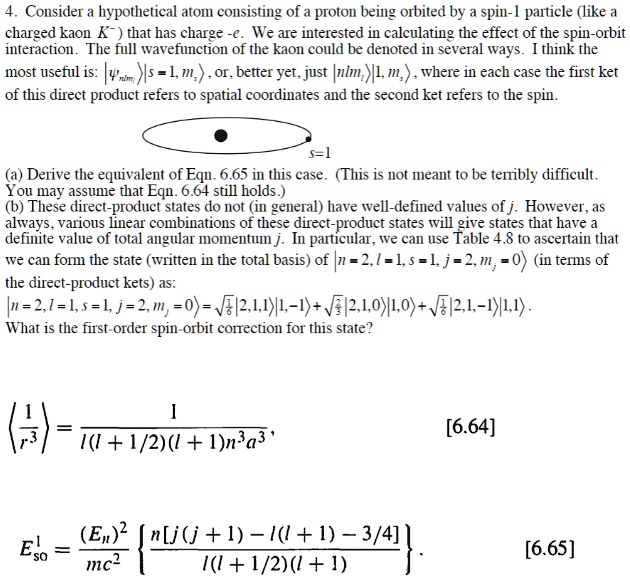
Consider a hypothetical atom consisting of a proton being orbited by a spin-1/2 particle (like a charged kaon K-) that has charge -e. We are interested in calculating the effect of the spin-orbit interaction. The full wavefunction of the kaon could be denoted in several ways. I think the most useful is: [|nlm⟩|s=1,m⟩, or, better yet, just [|nlm⟩|1,m⟩, where in each case the first ket of this direct product refers to spatial coordinates and the second ket refers to the spin.
(a) Derive the equivalent of Eqn. 6.65 in this case. This is not meant to be terribly difficult. You may assume that Eqn. 6.64 still holds.
(b) These direct-product states do not (in general) have well-defined values of j. However, as always, various linear combinations of these direct-product states will give states that have a definite value of total angular momentum j. In particular, we can use Table 4.8 to ascertain that we can form the state (written in the total basis) of |n = 2, l = 1, s = 1, j = 2, m = 0) (in terms of the direct-product kets) as |n=2, l=1, s=1, j=2, m=0⟩ = |2,1,1⟩|1,-1⟩ + |2,1,0⟩|1,0⟩ + |2,1,-1⟩|1,1⟩. What is the first-order spin-orbit correction for this state?
[Eqn. 6.64]
1/2(l+1)(l+1/2)n^3a^3(E^2 - (n[j(j+1)-l(l+1)]/2)mc^2
[Eqn. 6.65]