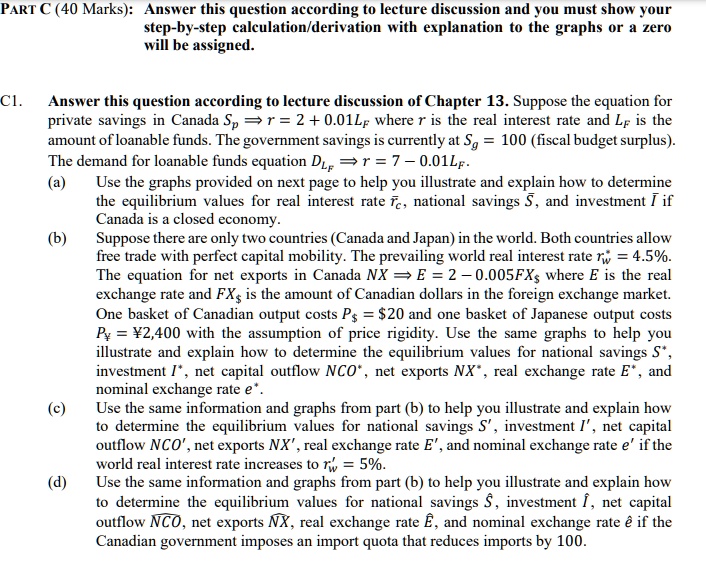
PART C (40 Marks): Answer this question according to lecture discussion and you must show your work.
C1.
Answer this question according to lecture discussion of Chapter 13. Suppose the equation for private savings in Canada is Sp = 2 + 0.01Lp, where Sp is the private savings, and Lp is the level of income.
The demand for loanable funds equation is DL(r) = 7 - 0.01LF, where DL(r) is the demand for loanable funds and LF is the level of investment.
(a) Use the graphs provided on the next page to help you illustrate and explain how to determine the equilibrium values for the real interest rate (r), national savings (S), and investment (I) if Canada is a closed economy.
(b) Suppose there are only two countries (Canada and Japan) in the world. Both countries allow free trade with perfect capital mobility. The prevailing world real interest rate is r = 4.5%. The equation for net exports in Canada is NX = E = 2 - 0.005FXs, where NX is net exports, E is the real exchange rate, and FX is the amount of Canadian dollars in the foreign exchange market. One basket of Canadian output costs P = $20 and one basket of Japanese output costs P = 2,400 with the assumption of price rigidity. Use the same graphs to help you illustrate and explain how to determine the equilibrium values for national savings (S*), investment (I*), net capital outflow (NCO*), net exports (NX*), real exchange rate (E*), and nominal exchange rate (e*).
(c) Use the same information and graphs from part (b) to help you illustrate and explain how to determine the equilibrium values for national savings (S'), investment (I), net capital outflow (NCO), net exports (NX), real exchange rate (E), and nominal exchange rate (e) if the world real interest rate increases to rw = 5%.
(d) Use the same information and graphs from part (b) to help you illustrate and explain how to determine the equilibrium values for national savings (S), investment (I), net capital outflow (NCO), net exports (NX), real exchange rate (E), and nominal exchange rate (e) if the Canadian government imposes an import quota that reduces imports by 100.