Ace - AI Tutor
Ask Our Educators
Textbooks
My Library
Flashcards
Scribe - AI Notes
Notes & Exams
Download App
justin lambert

justin l.

Divider

Questions asked

BEST MATCH

Calculate the osmotic pressure of a solution containing 19.00 mg of hemoglobin in 15.4 mL of solution at 31 ∘C . The molar mass of hemoglobin is 6.5×10⁴ g/mol. Express your answer in atmospheres

View Answer
divider
BEST MATCH

How (and why) does a minority police subculture develop in a police organization

View Answer
divider
BEST MATCH

Most scholars agree on what should be considered a crime. True False

View Answer
divider
BEST MATCH

Net income divided by net sales is the calculation for: Group of answer choices operating profit margin net profit margin gross profit margin net operating profit after taxes margin

View Answer
divider
BEST MATCH

given by the equation P = P0 + ρgh, where P0 is the atmospheric pressure, ρ is the water mass density, g is the acceleration due to gravity, and h is the depth of the submarine below the ocean surface. Substituting the given values into the equation, we get: P = 101,000 Pa + (1020 kg/m^3)(9.81 m/s^2)(65 m) Calculating the total pressure, we find: P = 101,000 Pa + 637,953 Pa Therefore, the total pressure at a depth of 65m below the ocean surface is 738,953 Pa.

View Answer
divider
BEST MATCH

Juan does not consider himself to be racist and considers himself as a fairly accepting individual. When walking home from work, Juan takes a less-direct route because he does not want to interact with members of a local synagogue. Which form of racism is Juan displaying? A. Old-fashioned racism B. Tokenism C. Genuine likes and dislikes D. Aversive racism

View Answer
divider
BEST MATCH

The department of highway improvements want to design a surface that will be structurally efficient for a 50km highway. One important consideration is the volume of heavy freight traffic on interstate. State weigh stations report that the average number of heavy-duty trailers travelling on the 50km segment of the interstate is 72 per hour. However, the department engineers believe that the volume of traffic is greater than the average reported. To valid this theory, the department monitor the highway for 50, 1-hour periods randomly selected throughout the month. Given that $y = 75$ and $s = 15.0$ of heavy freight traffic for the 50 sampled hours a. What is the null hypothesis and alternative hypothesis for this case? (2 marks) b. What is the test statistic for the 50 sampled hours? (3 marks) c. Find the rejection region if $\alpha = 0.02$. (3 marks) d. Based on 1(c), do the data support the department's theory that the volume of traffic is greater than 72 per hour? Explain. (3 marks) e. If the mean number of heavy freight trailers traveling on the 50km segment of the interstate is in fact 78 per hour. What is the probability that we would fail to reject null hypothesis on 1(a) if mean number of heavy freight actually equal to 78? Explain. (4 marks) f. Suppose that the alternative of interest had been $H_a: \mu = 72$. Find the observed significance level, $p$-value for the statistical test. Is the p-value support the null hypothesis for this case? Assume that $\alpha = 0.1$. Explain. (3 marks)

View Answer
divider
BEST MATCH

• The numbers written on edges represent the distance between the nodes while the numbers written on nodes represent the heuristic values. Find the shortest solution path to move from A to Z using A* Algorithm.

View Answer
divider
BEST MATCH

Determine the equation of the line normal to the curve $g(x) = 2\sin x + 4\cos x$ when $x = \frac{\pi}{4}$. Do NOT use decimals.

View Answer
divider
BEST MATCH

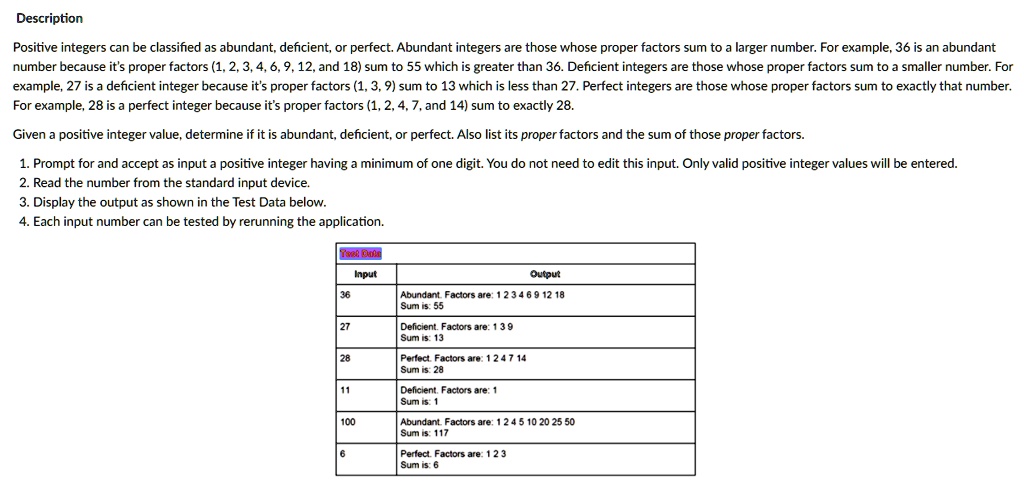
Description Positive integers can be classified as abundant, deficient, or perfect. Abundant integers are those whose proper factors sum to a larger number. For example, 36 is an abundant number because it's proper factors (1, 2, 3, 4, 6, 9, 12, and 18) sum to 55 which is greater than 36. Deficient integers are those whose proper factors sum to a smaller number. For example, 27 is a deficient integer because it's proper factors (1, 3, 9) sum to 13 which is less than 27. Perfect integers are those whose proper factors sum to exactly that number. For example, 28 is a perfect integer because it's proper factors (1, 2, 4, 7, and 14) sum to exactly 28. Given a positive integer value, determine if it is abundant, deficient, or perfect. Also list its proper factors and the sum of those proper factors. 1. Prompt for and accept as input a positive integer having a minimum of one digit. You do not need to edit this input. Only valid positive integer values will be entered. 2. Read the number from the standard input device. 3. Display the output as shown in the Test Data below. 4. Each input number can be tested by rerunning the application. Input Output 36 Abundant. Factors are: 1 2 3 4 6 9 12 18 Sum is: 55 27 Deficient. Factors are: 1 3 9 Sum is: 13 28 Perfect. Factors are: 1 2 4 7 14 Sum is: 28 11 Deficient. Factors are: 1 Sum is: 1 100 Abundant. Factors are: 1 2 4 5 10 20 25 50 Sum is: 117 6 Perfect. Factors are: 1 2 3 Sum is: 6
View Answer
divider