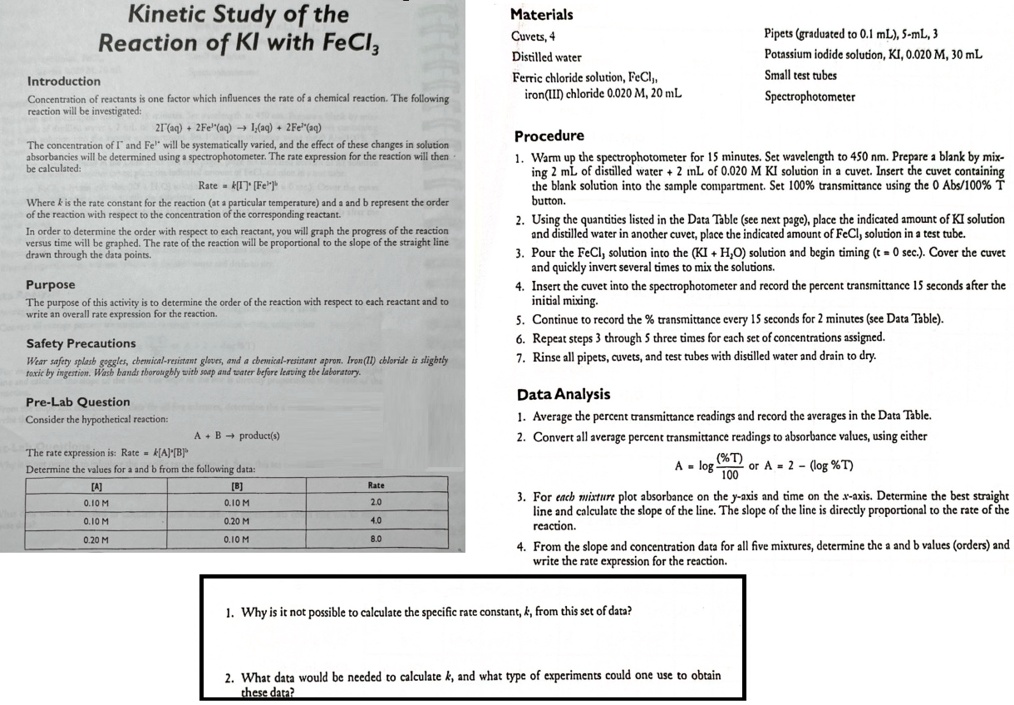
1. Why is it not possible to calculate the specific rate constant k, from this set of data?
2. What data would be needed to calculate k, and what type of experiments could one use to obtain these data?
Why is it not possible to calculate the specific rate constant, k, from this set of data?
What data would be needed to calculate k, and what type of experiments could one use to obtain these data?
Kinetic Study of the Materials
Cuvets, 4 Distilled water Ferric chloride solution FeCl ironII1 chloride 0.020 M, 20 mL
Reaction of KI with FeCl
Pipets graduated to 0.1 mL, 5-mL, 3 Potassium iodide solution KI, 0.020 M, 30 mL Small test tubes Spectrophotometer
Introduction
Concentration of reactants is one factor which influences the rate of a chemical reaction. The following reaction will be investigated: 2Iaq + 2Feaq Iaq + 2Feaq The concentration of I and Fe will be systematically varied, and the effect of these changes in solution absorbances will be determined using a spectrophotometer. The rate expression for the reaction will then be calculated: Rate = [I][Fe] Where k is the rate constant for the reaction (at a particular temperature) and a and b represent the order of the reaction with respect to the concentration of the corresponding reactant. In order to determine the order with respect to each reactant, you will graph the progress of the reaction versus time will be graphed. The rate of the reaction will be proportional to the slope of the straight line drawn through the data points.
Procedure
1. Warm up the spectrophotometer for 15 minutes. Set wavelength to 450 nm. Prepare a blank by mixing 2 mL of distilled water + 2 mL of 0.020 M KI solution in a cuvet. Insert the cuvet containing the blank solution into the sample compartment. Set 100% transmittance using the 0 Abs/100% T button.
2. Using the quantities listed in the Data Table (see next page), place the indicated amount of KI solution and distilled water in another cuvette, place the indicated amount of FeCl solution in a test tube.
3. Pour the FeCl solution into the KI + HO solution and begin timing t = 0 sec. Cover the cuvet and quickly invert several times to mix the solutions.
4. Insert the cuvet into the spectrophotometer and record the percent transmittance 15 seconds after the initial mixing.
5. Continue to record the % transmittance every 15 seconds for 2 minutes (see Data Table 6. Repeat steps 3 through 5 three times for each set of concentrations assigned 7. Rinse all pipets, cuvets, and test tubes with distilled water and drain to dry.
Purpose
The purpose of this activity is to determine the order of the reaction with respect to each reactant and to write an overall rate expression for the reaction.
Safety Precautions
Wear safety splash goggles, chemical-resistant gloves, and a chemical-resistant apron. Iron chloride is highly toxic by ingestion. Wash hands thoroughly with soap and water before leaving the laboratory.
Data Analysis
1. Average the percent transmittance readings and record the averages in the Data Table
2. Convert all average percent transmittance readings to absorbance values, using either %T) A = log or A = 2 - log %T 100
3. For each mixture, plot absorbance on the y-axis and time on the x-axis. Determine the best straight line and calculate the slope of the line. The slope of the line is directly proportional to the rate of the reaction.
4. From the slope and concentration data for all five mixtures, determine the a and b values (orders) and write the rate expression for the reaction.
Pre-Lab Question
Consider the hypothetical reaction:
snpodg + The rate expression is: Rate = k[A][B] Determine the values for a and b from the following data: [A] [B] 0.10M 0.10M 0.10M 0.20 M 0.20M 0.10M
Rate 2.0 4.0 0'8
1. Why is it not possible to calculate the specific rate constant k, from this set of data
2. What data would be needed to calculate k, and what type of experiments could one use to obtain these data?