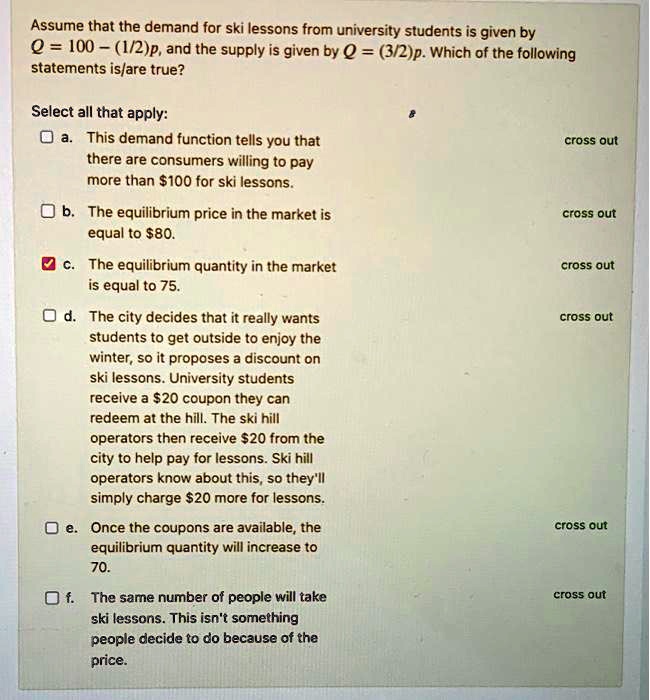
Assume that the demand for ski lessons from university students is given by
Q = 100 - (1/2)p, and the supply is given by Q = (3/2)p. Which of the following
statements is/are true?
Select all that apply:
a. This demand function tells you that
there are consumers willing to pay
more than $100 for ski lessons.
b. The equilibrium price in the market is
equal to $80.
? c. The equilibrium quantity in the market
is equal to 75.
d. The city decides that it really wants
students to get outside to enjoy the
winter, so it proposes a discount on
ski lessons. University students
receive a $20 coupon they can
redeem at the hill. The ski hill
operators then receive $20 from the
city to help pay for lessons. Ski hill
operators know about this, so they'll
simply charge $20 more for lessons.
e. Once the coupons are available, the
equilibrium quantity will increase to
70.
f. The same number of people will take
ski lessons. This isn't something
people decide to do because of the
price.