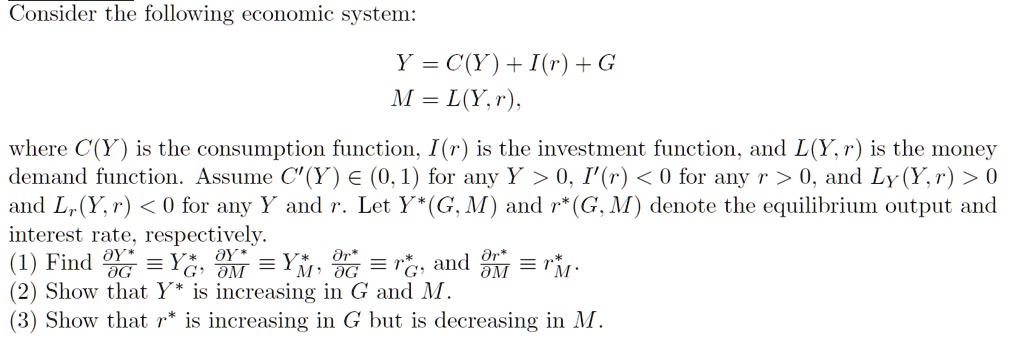
Consider the following economic system:
Y = C(Y) + I(r) + G
M = L(Y, r),
where C(Y) is the consumption function, I(r) is the investment function, and L(Y, r) is the money
demand function. Assume C'(Y) ? (0,1) for any Y > 0, I'(r) <0 for any r > 0, and L<sub>Y</sub>(Y, r) > 0
and L<sub>r</sub>(Y,r) < 0 for any Y and r. Let Y*(G, M) and r* (G, M) denote the equilibrium output and
interest rate, respectively.
(1) Find $\frac{\partial Y*}{\partial G} = Y_G^*$, $\frac{\partial Y*}{\partial M} = Y_M^*$, $\frac{\partial r*}{\partial G} = r_G^*$, and $\frac{\partial r*}{\partial M} = r_M^*$.
(2) Show that Y* is increasing in G and M.
(3) Show that r* is increasing in G but is decreasing in M.