Ace - AI Tutor
Ask Our Educators
Textbooks
My Library
Flashcards
Scribe - AI Notes
Notes & Exams
Download App
Kaan B

Kaan B.

Divider

Questions asked

INSTANT ANSWER

Find the point, \( P \), at which the line intersects the plane. \( x=-9-10 t, y=-5-9 t, z=6-5 t ; 2 x-9 y-6 z=10 \) The point, P, at which the line intersects the plane is (Simplify your answer. Type an ordered triple.)

View Answer
divider
ANSWERED

Subhadeepta Sahoo verified

Numerade educator

Find the distance, d, between the point S(7,10,6) and the plane 7x + 1y + 1z = 14. The distance, d, is (Round to the nearest hundredth.)

View Answer
divider
ANSWERED

Hafiz Shahzaib verified

Numerade educator

Question 1 a) Prove that, the electric field reigning in between the plates of a parallel plate capacitor, is constant. Hint: Show, via using Gauss Law that a uniformly charged infinite plane of surface density (sigma), creates at any altitude above or below it, an electric field intensity (E=sigma/2varepsilon_{0}), written in MKS unit system. b) Despite this result, the electric field intensity between the plates of a capacitor amounts to (E=sigma/varepsilon_{0}). Why? Is the outcome valid near the edges of the plates? c) The width between the plates is (d). The electric potential between them amounts to, (V=Ed). Why? d) Suppose the surface area of each plate is (S), and the intensity of the stored charge is (q). Show that the capacitance (C=q/V) can be expressed as (C=Svarepsilon_{0}/d). e) The MKS unit for (C) in is Farad (Coulomb/Volt). Suppose (C=1 imes10^{-12}) Farad, and (V=1) Volt. How many electrons under the given circumstances are moved from one plate to the other? The electron charge magnitude is (e=1.6 imes10^{-19}) Coulomb.

View Answer
divider
INSTANT ANSWER

d) Calculate \( \mathrm{d} \), in the light of the following data, in terms of the radius \( \mathrm{R} \) of the Gold nucleus, which had been afterwards measured. \( \frac{1}{4 \pi \varepsilon_{o}}=9 \times 10^{9} \mathrm{~N} \mathrm{~m}^{2} / \mathrm{C}^{2}(\mathrm{MKS}), \Delta \mathrm{V}=6 \times 10^{6} \mathrm{Volt}, \mathrm{Z}=79, \mathrm{R}=8 \times 10^{-15} \mathrm{~m} \) e) Given that alpha's mass is \( \mathrm{m}=6.6 \mathrm{x} 10^{-27} \mathrm{~kg} \), find its velocity in meters/ second.

View Answer
divider
ANSWERED

Ivan Kochetkov verified

Numerade educator

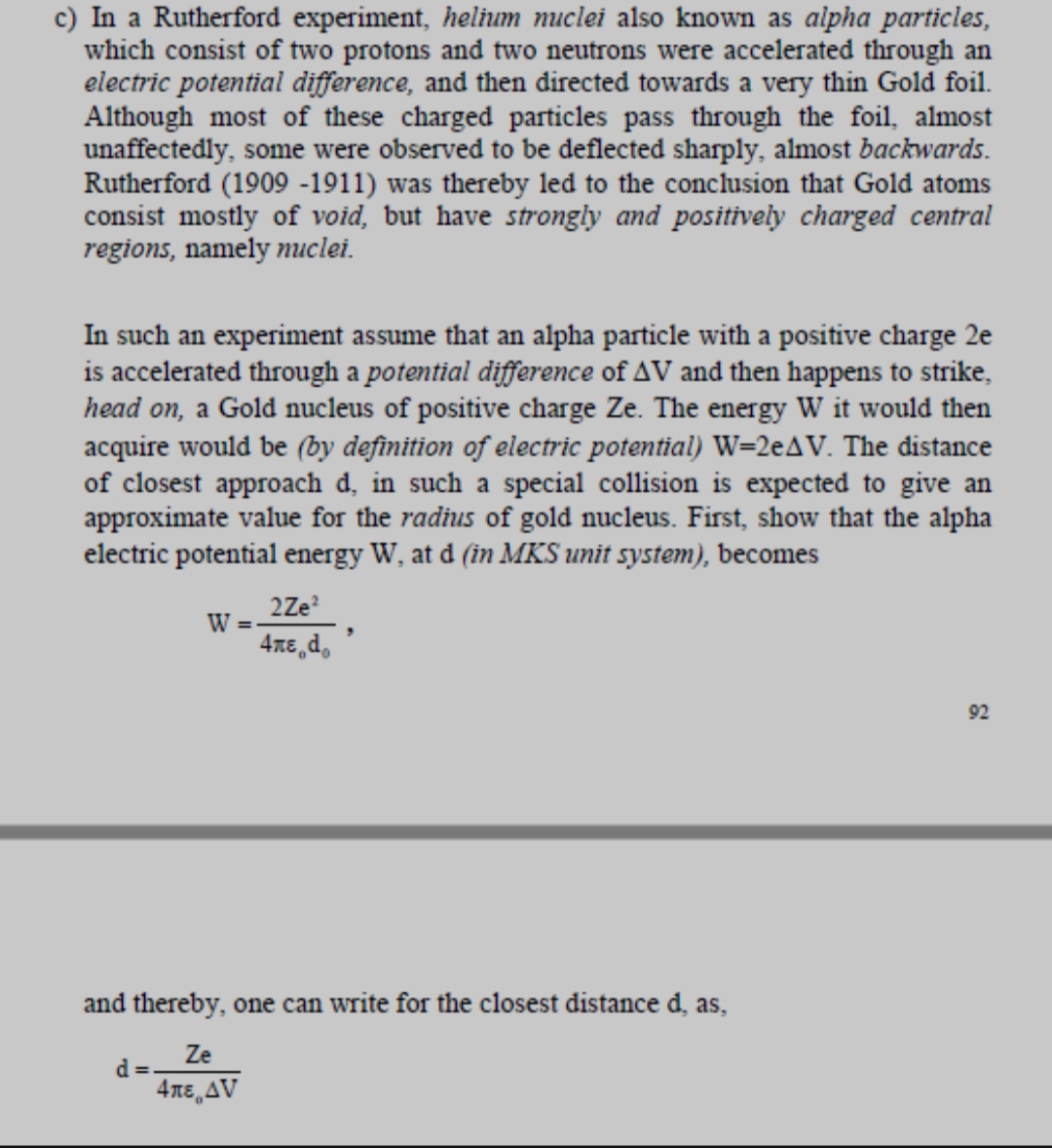
c) In a Rutherford experiment, helium nuclei also known as alpha particles, which consist of two protons and two neutrons were accelerated through an electric potential difference, and then directed towards a very thin Gold foil. Although most of these charged particles pass through the foil, almost unaffectedly, some were observed to be deflected sharply, almost backwards. Rutherford (1909 -1911) was thereby led to the conclusion that Gold atoms consist mostly of void, but have strongly and positively charged central regions, namely nuclei. In such an experiment assume that an alpha particle with a positive charge 2e is accelerated through a potential difference of ?V and then happens to strike, head on, a Gold nucleus of positive charge Ze. The energy W it would then acquire would be (by definition of electric potential) W=2e?V. The distance of closest approach d, in such a special collision is expected to give an approximate value for the radius of gold nucleus. First, show that the alpha electric potential energy W, at d (in MKS unit system), becomes W = 2Ze² / 4???d? and thereby, one can write for the closest distance d, as, d = Ze / 4????V
View Answer
divider
INSTANT ANSWER

Question 1 One can conceive an atomic nucleus, as a sphere charged uniformly, and positively. Let the proton number be Z; the charge intensity of either electron or proton is \( \mathrm{e}=1.6 \times 10^{-19} \) Coulomb. Thereby the charge intensity of the nucleus at hand, becomes Ze. Let its radius be \( R \). a) Consider a location denoted by the distance \( r \) to the center of the nucleus, such that \( \mathrm{r}>\mathrm{R} \), and write at \( \mathrm{r} \) (in MKS unit system), the electric field intensity \( \mathrm{E}(\mathrm{r}) \) and the electric potential \( \mathrm{V}(\mathrm{r}) \) created by the nucleus. b) Write the relationship between these two quantitites, and the reason for it.

View Answer
divider
ANSWERED

Supratim Pal verified

Numerade educator

a) We write that, the electric field reigning in between the plates of a parallel plate capacitor, is constant. Why? Hint: Show, via using Gauss Law that a uniformly charge infinite plane of surface density ?, creates at any altitude above or below it, an electric field intensity E= ?/2?? , written n MKS unit system. b) Despite this result, the electric field intensity between the plates of a capacitor amounts to E= ?/?? Why? Is the outcome valid near the edges of the plates?

View Answer
divider
ANSWERED

Sai Sai verified

Numerade educator

Question 1 a) In J. J. Thomson experiment (1897), an electron moving horizontally with a constant speed v0 enters in between the horizontal plates of a capacitor. The electric field strength between the plates of length L and distance d, is E. The vertical deviation of the electron at the moment of exit from the field region is measured to be Y. Derive the expression giving the electron's charge to mass ratio, i.e. e/m to be 2v0^2Y/(EL^2). (Recall that Thomson received Nobel Prize for his achievement.) b) Calculate e/m, knowing the following data. E=1.6x10^4 Newton/Coulomb, L=10 cm, Y=2.9 cm, v=2.19x10^4 km/s. (Be careful to use coherent units.)

View Answer
divider