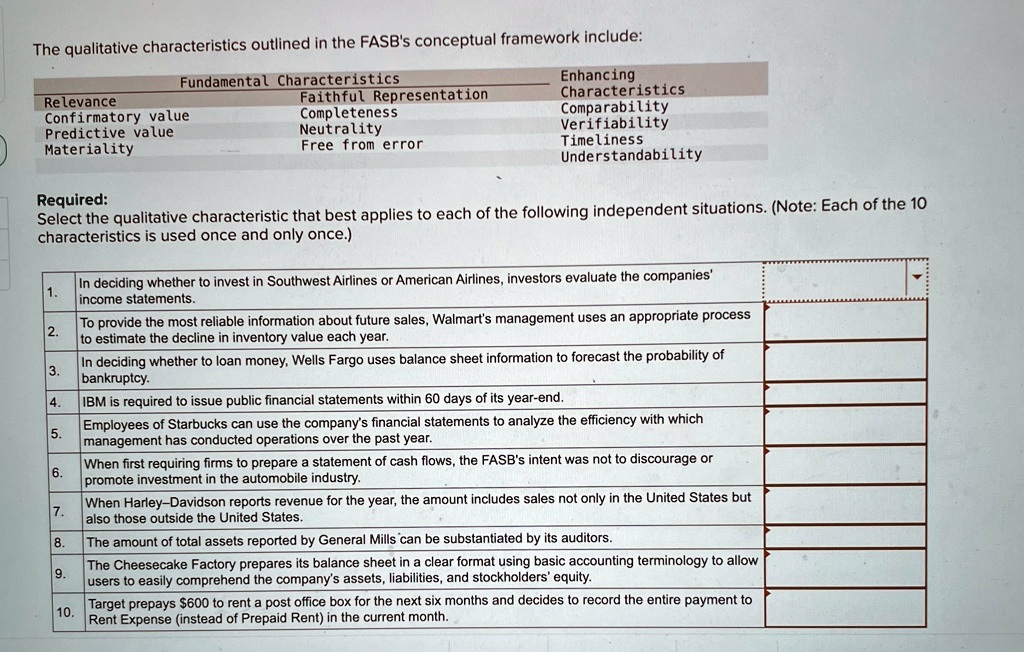
The qualitative characteristics outlined in the FASB's conceptual framework include:
Fundamental Characteristics
Relevance
Confirmatory value
Predictive value
Materiality
Faithful Representation
Completeness
Neutrality
Free from error
Enhancing Characteristics
Comparability
Verifiability
Timeliness
Understandability
Required:
Select the qualitative characteristic that best applies to each of the following independent situations. (Note: Each of the 10
characteristics is used once and only once.)
1. In deciding whether to invest in Southwest Airlines or American Airlines, investors evaluate the companies'
income statements.
2. To provide the most reliable information about future sales, Walmart's management uses an appropriate process
to estimate the decline in inventory value each year.
3. In deciding whether to loan money, Wells Fargo uses balance sheet information to forecast the probability of
bankruptcy.
4. IBM is required to issue public financial statements within 60 days of its year-end.
5. Employees of Starbucks can use the company's financial statements to analyze the efficiency with which
management has conducted operations over the past year.
6. When first requiring firms to prepare a statement of cash flows, the FASB's intent was not to discourage or
promote investment in the automobile industry.
7. When Harley-Davidson reports revenue for the year, the amount includes sales not only in the United States but
also those outside the United States.
8. The amount of total assets reported by General Mills can be substantiated by its auditors.
9. The Cheesecake Factory prepares its balance sheet in a clear format using basic accounting terminology to allow
users to easily comprehend the company's assets, liabilities, and stockholders' equity.
10. Target prepays $600 to rent a post office box for the next six months and decides to record the entire payment to
Rent Expense (instead of Prepaid Rent) in the current month.