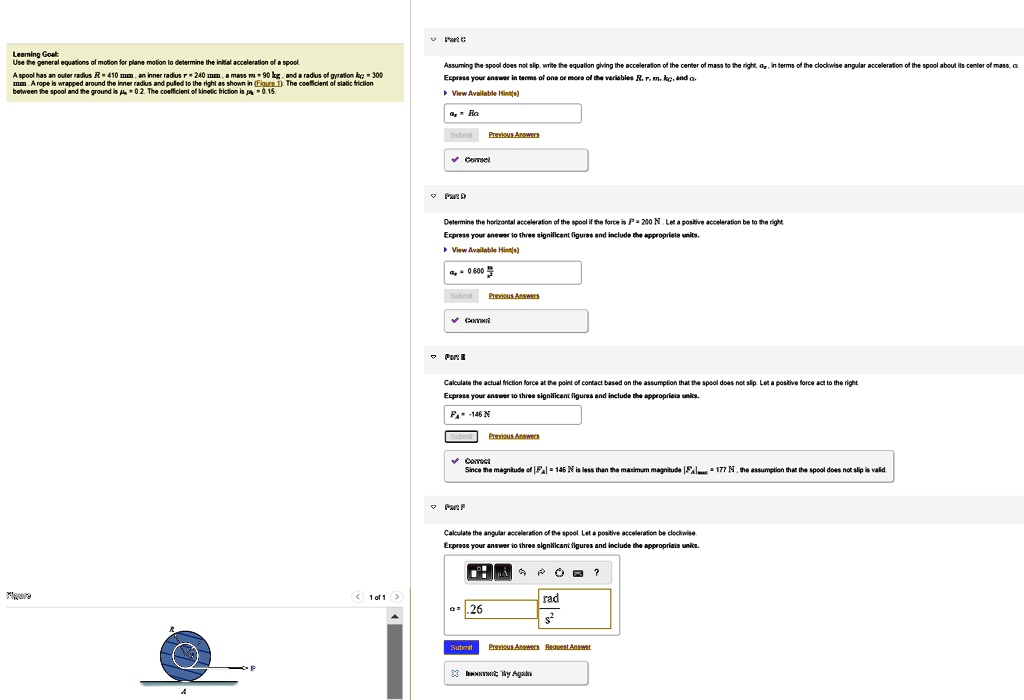
Learning Goal:
Use the general equations of motion for plane motion to determine the initial acceleration of a spool.
A spool has an outer radius R = 410 mm, an inner radius r = 240 mm, a mass m = 90 kg, and a radius of gyration k_G = 300 mm. A rope is wrapped around the inner radius and pulled to the right as shown in (Figure 1). The coefficient of static friction between the spool and the ground is μ_s = 0.2. The coefficient of kinetic friction is μ_k = 0.15.
Figure
Calculate the angular acceleration of the spool. Let a positive acceleration be clockwise.
Express your answer to three significant figures and include the appropriate units.
Correct
Since the magnitude of |F_A| = 146 N is less than the maximum magnitude |F_A|max = 177 N, the assumption that the spool does not slip is valid.
Calculate the actual friction force at the point of contact based on the assumption that the spool does not slip. Let a positive force act to the right.
Express your answer to three significant figures and include the appropriate units.
F_A = -146 N
Previous Answer
Determine the horizontal acceleration of the spool if the force is P = 200 N. Let a positive acceleration be to the right.
Express your answer to three significant figures and include the appropriate units.
View Available Hint(s)
a_x = 0.600 m/s^2
Correct
Part E
Express your answer in terms of one or more of the variables R, r, m, k_G, and α
View Available Hint(s)
a_x
Previous Answer
Correct
Part D
Previous Answers
Part F
Express your answer to three significant figures and include the appropriate units.
√(rad/s^2)
Part
Learning Goal: Use the general equations of motion for plane motion to determine the initial acceleration of a spool. A spool has an outer radius R = 410 mm, an inner radius r = 240 mm, a mass m = 90 kg, and a radius of gyration k_G = 300 mm. A rope is wrapped around the inner radius and pulled to the right as shown in Figure 1. The coefficient of static friction between the spool and the ground is μ_s = 0.2. The coefficient of kinetic friction is μ_k = 0.15. Calculate the angular acceleration of the spool. Let a positive acceleration be clockwise. Express your answer to three significant figures and include the appropriate units. Since the magnitude of |F_A| = 146 N is less than the maximum magnitude |F_A|max = 177 N, the assumption that the spool does not slip is valid. Calculate the actual friction force at the point of contact based on the assumption that the spool does not slip. Let a positive force act to the right. Express your answer to three significant figures and include the appropriate units. F_A = -146 N. Determine the horizontal acceleration of the spool if the force is P = 200 N. Let a positive acceleration be to the right. Express your answer to three significant figures and include the appropriate units. a_x = 0.600 m/s^2. Express your answer in terms of one or more of the variables R, r, m, k_G, and α. √(rad/s^2).