Ace - AI Tutor
Ask Our Educators
Textbooks
My Library
Flashcards
Scribe - AI Notes
Notes & Exams
Download App
karen brown

karen b.

Divider

Questions asked

BEST MATCH

When considering the cell cycle, cell growth occurs during: telophase prophase no growth occurs, only cell division interphase

View Answer
divider
BEST MATCH

After the death of Julius Caesar, Multiple Choice the Roman Republic was restored. Hannibal led a plebeian uprising against the patricians. Alexander the Great conquered Rome. a series of civil wars ended in the one-man rule of Augustus.

View Answer
divider
BEST MATCH

Access control is implemented at the presentation layer only and a server-side authorization check is missing. What is the application vulnerable to? Select the correct option(s) and click submit. Broken Access Control Session Hijacking

View Answer
divider
BEST MATCH

The demand for skilled labor is low in relatively small bargaining units because: A. certain skilled labor is essential for the production. B. market demand for the final product is inelastic. C. substitute or replacement workers are easily available. D. the cost of labor is lower than production cost.

View Answer
divider
BEST MATCH

- Prairie fringed orchid: 1. Cost: Preserving the prairie fringed orchid may require significant financial resources for habitat restoration, protection, and monitoring, which could be seen as a downside by individuals or organizations with limited budgets. 2. Land Use Conflicts: Protecting the prairie fringed orchid's habitat may lead to conflicts with other land uses, such as agriculture or development, potentially causing tensions between conservation efforts and economic interests. 3. Invasive Species Control: Preserving the prairie fringed orchid may involve the control of invasive species that threaten its survival, which could require the use of pesticides or other methods that may have unintended consequences on the ecosystem.

View Answer
divider
BEST MATCH

The autonomous consumption expenditures and autonomous investment expenditures in an economy are $500 and $400, respectively. It is also observed that individuals spend 60% of their additional income on consumption. Using the information provided above, the aggregate expenditure function for this economy is: AE = 900 + 0.60Y Part 2 The simple multiplier for this economy can be calculated as 2.5. Part 3 The value of the simple multiplier implies that a $200 increase in the autonomous investment expenditures would lead to a $ enter your response here decrease in the equilibrium level of actual income.

View Answer
divider
BEST MATCH

The matrix \begin{bmatrix} 9 & 5 & 19 \\ 1 & 5 & 11 \\ -5 & -5 & -15 \end{bmatrix} \\ A = \begin{bmatrix} 9 & 5 & 19 \\ 1 & 5 & 11 \\ -5 & -5 & -15 \end{bmatrix} has eigenvalues -5, 0, and 4. Find its eigenvectors. The eigenvalue -5 has associated eigenvector The eigenvalue 0 has associated eigenvector The eigenvalue 4 has associated eigenvector

View Answer
divider
BEST MATCH

What products would result if $^{14}C$ underwent the following reactions: (Each answer will be used once.) positron decay electron capture alpha decay 1. $^{14}_5B$ 2. $^{10}_4Be$ 3. $^{14}_7N$ 4. $^{15}_6C$ 5. $^{14}_8N$ 6. $^{14}_6C$ 7. $^{10}_6C$

View Answer
divider
BEST MATCH

Problem 4: The sports car, having a mass of 1500 kg, travels horizontally along a 30° banked track which is circular and has a radius of curvature of $p = 150$ m. If the coefficient of static friction between the tires and the road is $\mu_s = 0.25$, determine the

View Answer
divider
BEST MATCH

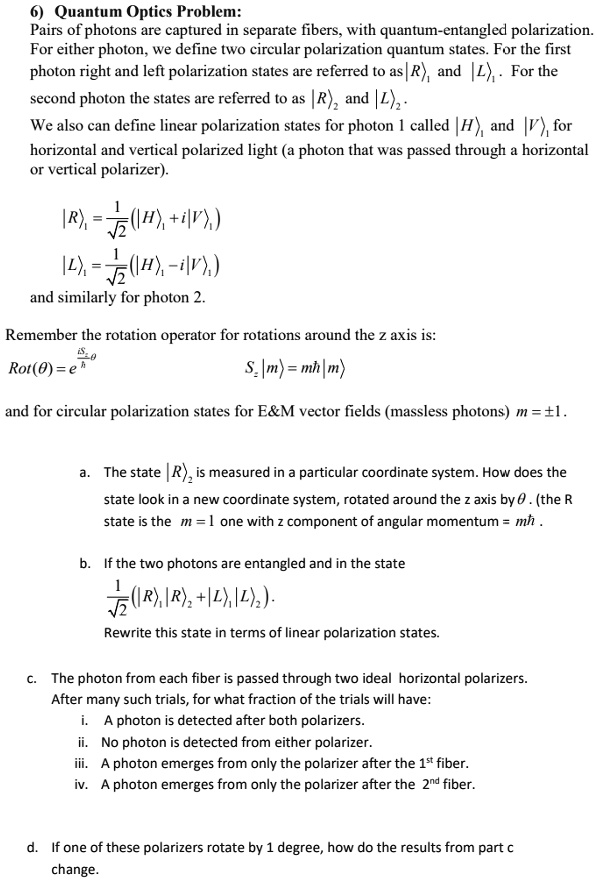
6) Quantum Optics Problem: Pairs of photons are captured in separate fibers, with quantum-entangled polarization. For either photon, we define two circular polarization quantum states. For the first photon right and left polarization states are referred to as $\left| R \right\rangle_1$, and $\left| L \right\rangle_1$. For the second photon the states are referred to as $\left| R \right\rangle_2$, and $\left| L \right\rangle_2$. We also can define linear polarization states for photon 1 called $\left| H \right\rangle_1$, and $\left| V \right\rangle_1$, for horizontal and vertical polarized light (a photon that was passed through a horizontal or vertical polarizer). $\left| R \right\rangle_1 = \frac{1}{\sqrt{2}} (\left| H \right\rangle_1 + i \left| V \right\rangle_1)$ $\left| L \right\rangle_1 = \frac{1}{\sqrt{2}} (\left| H \right\rangle_1 - i \left| V \right\rangle_1)$ and similarly for photon 2. Remember the rotation operator for rotations around the z axis is: $Rot(\theta) = e^{-i \frac{S_z \theta}{\hbar}}$ $S_z \left| m \right\rangle = m\hbar \left| m \right\rangle$ and for circular polarization states for E&M vector fields (massless photons) m = ±1. a. The state $\left| R \right\rangle_2$ is measured in a particular coordinate system. How does the state look in a new coordinate system, rotated around the z axis by $\theta$. (the R state is the m = 1 one with z component of angular momentum = $m\hbar$. b. If the two photons are entangled and in the state $\frac{1}{\sqrt{2}} (\left| R \right\rangle_1 \left| R \right\rangle_2 + \left| L \right\rangle_1 \left| L \right\rangle_2)$. Rewrite this state in terms of linear polarization states. c. The photon from each fiber is passed through two ideal horizontal polarizers. After many such trials, for what fraction of the trials will have: i. A photon is detected after both polarizers. ii. No photon is detected from either polarizer. iii. A photon emerges from only the polarizer after the 1$^{st}$ fiber. iv. A photon emerges from only the polarizer after the 2$^{nd}$ fiber. d. If one of these polarizers rotate by 1 degree, how do the results from part c change.
View Answer
divider