n = 79,000 N.
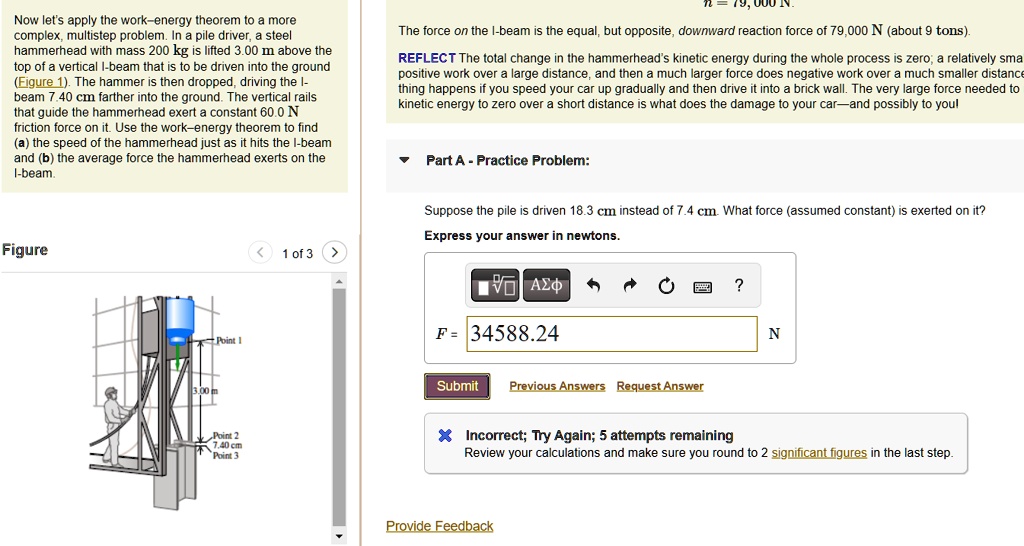
Now let's apply the work-energy theorem to a more complex, multistep problem. In a pile driver, a steel hammerhead with mass 200 kg is lifted 3.00 m above the top of a vertical I-beam that is to be driven into the ground (Figure 1). The hammer is then dropped, driving the I-beam 7.40 cm farther into the ground. The vertical rails that guide the hammerhead exert a constant 60.0 N friction force on it. Use the work-energy theorem to find (a) the speed of the hammerhead just as it hits the I-beam and (b) the average force the hammerhead exerts on the I-beam.
The force on the I-beam is equal, but opposite, to the downward reaction force of 79,000 N (about 9 tons).
REFLECT: The total change in the hammerhead's kinetic energy during the whole process is zero; a relatively small positive work over a large distance, and then a much larger force does negative work over a much smaller distance. The same thing happens if you speed your car up gradually and then drive it into a brick wall. The very large force needed to reduce kinetic energy to zero over a short distance is what does the damage to your car - and possibly to you.
Part A - Practice Problem:
Suppose the pile is driven 18.3 cm instead of 7.4 cm. What force (assumed constant) is exerted on it?
Express your answer in newtons.
Figure 1 of 3
AE
F = 34588.24 N
Submit
Previous Answers Request Answer
Point 2: 7.40 cm
Point 3: Incorrect; Try Again; 5 attempts remaining
Review your calculations and make sure you round to 2 significant figures in the last step
Provide Feedback