Ace - AI Tutor
Ask Our Educators
Textbooks
My Library
Flashcards
Scribe - AI Notes
Notes & Exams
Download App
karen crosby

karen c.

Divider

Questions asked

BEST MATCH

If a random variable can take on a countable number of values, one would use a discrete distribution. True False

View Answer
divider
BEST MATCH

Given $f(x) = \begin{cases} 5x-5; & x < 8 \\ 4x+7; & x \geq 8, \end{cases}$ Find: $\lim_{x \to 8} f(x)$

View Answer
divider
BEST MATCH

The oscillator circuit shown has a 2.1-?? resistor, a 2.9-µF capacitor and a 850-V power supply. Find the period of oscillation if the gas tube fires at 108 V and extinguishes at 11 V. The gas tube has a 50-? resistance when firing and a 6-G? resistance when extinguished. How long does the capacitor charge each cycle? How long does the capacitor discharge each cycle? What is the total period of the cycle? Approximate the total period by assuming linear rise in voltage during charging and zero discharge time.

View Answer
divider
BEST MATCH

2Fe(s) + 3O2(g) → 2Fe2O3(s) If 12.5 g of iron(III) oxide is produced from 8.74 g of iron, how many grams of oxygen are needed for this reaction?

View Answer
divider
BEST MATCH

In Java, please. This is the code I have so far: ```java public static void main(String[] args) { Scanner input = new Scanner(System.in); Rectangle2D r1 = new Rectangle2D(); Rectangle2D r2 = new Rectangle2D(); System.out.println("Type in your x value."); double xValues = 2; //input.nextDouble(); System.out.println("Type in your y value."); double yValues = 1; //input.nextDouble(); System.out.println("Type in your width."); double w = 5; //input.nextDouble(); System.out.println("Type in your height."); double h = 6; //input.nextDouble(); r1.setX(xValues); r1.setY(yValues); r1.setHeight(h); r1.setWidth(w); System.out.println(r1); } class Rectangle2D { private double x; private double y; private double width; private double height; Rectangle2D() { x = 0; y = 0; width = 1; height = 1; } Rectangle2D(double xValue, double yValue, double w, double h) { x = xValue; } public void setX(double xValues) { x = xValues; } public double getX() { return x; } public void setY(double yValues) { y = yValues; } public double getY() { return y; } public void setWidth(double w) { width = w; } public double getWidth() { return width; } public void setHeight(double h) { height = h; } public double getHeight() { return height; } @Override public String toString() { return "The area of the rectangle is: " + getArea() + " and the perimeter is: " + getPerimeter(); } public double getArea() { return height * width; } public double getPerimeter() { return 2 * (width + height); } public boolean contains(double x, double y) { } public boolean contains(Rectangle2D rectangle) { } } ``` Create a Java public class inside a .java named FirstnameLastnameLab2 using your own first and last names. In the same .java file, design a private class named Rectangle2D that contains: - Two double data fields x and y that specify the center of the rectangle - Two double data fields width and height. - A no-arg constructor that creates a default rectangle with (0,0) for (x, y) and 1 for both width and height. - A constructor that creates a rectangle with a specific x, y, width, and height - Accessor and mutator methods (Getters and Setters) for all data fields - A toString method to print the object - A method named getArea that returns the area of the rectangle - A method named getPerimeter that returns the perimeter of the rectangle - A method named contains(double x, double y) that returns true if the specified point is inside the rectangle. - A method named contains(Rectangle2D rectangle) that returns true if the rectangle specified by the caller is inside this rectangle In your public class called FirstnameLastnameLab2, create a main method that tests your Rectangle2D class by doing the following items in order: 1. Create a default rectangle object named rl. 2. Allow the user to set the values for a rectangle object named r2. 3. Print the area and perimeter of each rectangle. 4. Test to see if rl contains r2 and output the result. 5. Allow the user to specify a point to see if it is inside rl or r2 and output the result. 6. Print both rl & r2. 7. Allow the user to change the data field values for rl. 8. Repeat steps 3, 4, and 5 above. 9. Print both objects again.
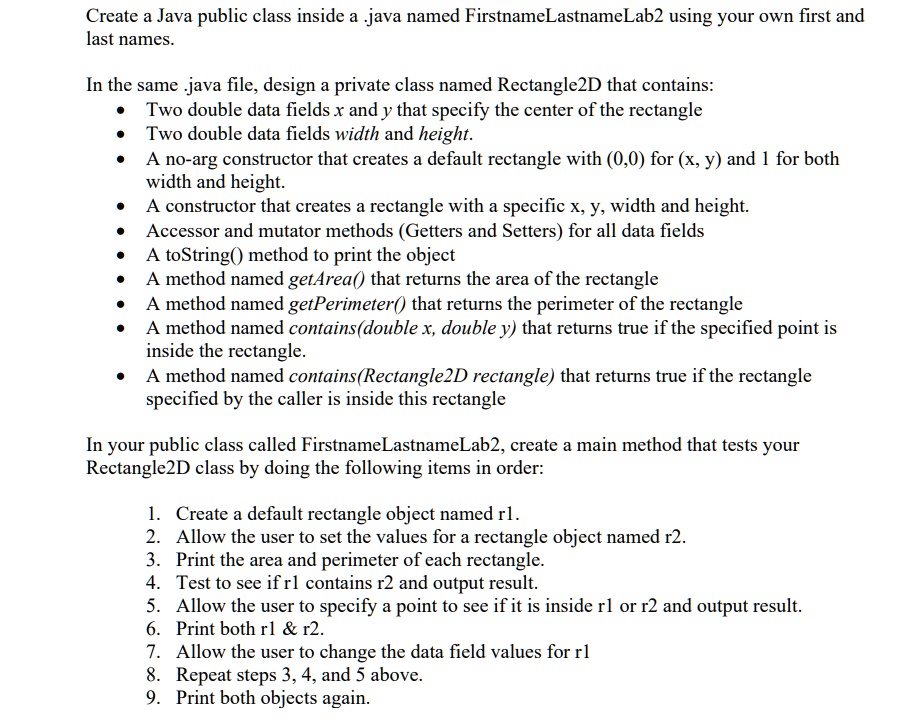
View Answer
divider
BEST MATCH

1. Define modulation. 2. What is carrier frequency? 3. Describe the two reasons that modulation is used for communications transmissions.

View Answer
divider
BEST MATCH

Consider a three-dimensional (3D) isotropic harmonic oscillator described by the Hamil-\ntonian (no hats on operators) $\qquad H = \frac{p^2}{2m} + \frac{m\omega^2 r^2}{2}, \qquad (p^2 = p_x^2 + p_y^2 + p_z^2, \ r^2 = x^2 + y^2 + z^2).$ (1) As implied by our discussion in class, its energy spectrum is a simple equidistant ladder: the\eigenvalues of the Hamiltonian (1) can be labeled as $\qquad E_n = (n + \frac{3}{2})\hbar\omega, \qquad n = 0, 1, 2,.....$ (2) When we were discussing 1D systems with symmetric potentials $V(x) = V(-x)$, we\realized that the stationary states $\psi(x)$ can be conveniently described as either even\$(\psi(-x) = \psi(x))$ or odd $(\psi(-x) = -\psi(x))$. In 3D systems with spherically-symmetric\potentials $V(r) = V(r)$, we generalize this idea to the symmetry with respect to the\inversion transformation: $r \to -r$. We define parity $P = \pm 1$ (even/odd) of state $\psi(r)$ \whenever $\psi(-r) = P\psi(r)$. Find the parity of stationary states belonging to ladder (2). Is each energy level $n$ \textquotedbl{}composed\textquotedbl{} of states with the same parity $P$?

View Answer
divider
BEST MATCH

2. For a buck dc-dc converter, consider all components to be ideal. Let initially assume that $v_o(t) \approx$ $V_o = 12V$ a. Calculate minimum value of L required to keep the converter operation in CCM under all conditions if $V_i = 24 - 48V$, $f_s = 30kHz$, and $P_o \ge 48W$. b. Calculate $\Delta V_{omax}$ if $C = 680\mu F$

View Answer
divider
BEST MATCH

2. The student collects the data shown in the attached table for the horizontal force acting on the fan-block system for different fan angles when the block has traveled a distance of 1 m. 1. On the below graph, on a sheet of graph paper, or using a computer program, use the data in the table to draw a plot of work done on the fan-block system by the fan vs fan angle. Include appropriate scaling on the axes and label the axis variables with appropriate units. 2. Linearize and re-plot your data, sketch an equation of best fit, and calculate the slope of the line of best fit. Include appropriate labels and scaling for your plot. 3. Based on your linearized plot, what does the slope of the line of best fit represent? \theta (degrees) Horizontal Force (N) 0 5.0 15 4.8 30 4.3 45 3.5 60 2.5 75 1.3 90 0.0 3

View Answer
divider
BEST MATCH

218 Geometric Dimensioning and Tolerancing 1 2 3 0.2 THIS SURFACE MUST BE ?WITHIN ?TOTAL. 0.2 6 7 0.2 9 10 11 0.3 A THIS SURFACE MUST BE 12 WITHIN 13TOTAL TO DATUM 14 0.3 8 A A Add the Correct Answer Symbol for 0.2 indicates Is 0.2 a +/- or total tolerance? Characteristic Tolerance Maximum material condition Least material condition Symbol for Symbol for Total tolerance A indicates Characteristic Tolerance Datum reference Maximum material condition Least material condition Worksheet 7-1 25±0.3 0.3 A 25±0.4 15 16 A Calculations 1. 2. 3. 4. 5. 6. 7. 8. 9. 10. 11. 12. 13. 14. 15. 16.

View Answer
divider