Ace - AI Tutor
Ask Our Educators
Textbooks
My Library
Flashcards
Scribe - AI Notes
Notes & Exams
Download App
karen davis

karen d.

Divider

Questions asked

BEST MATCH

Compute current I in this circuit. R 3R R R 2R 2R R E I 4R R R 2R 2R R 2R 3R

View Answer
divider
BEST MATCH

Question 5 An independent-measures study comparing two treatment conditions produces a t statistic with df = 18. If the two samples are the same size, how many participants were in each of the samples? 09 Ο 10 Ο 19 Ο 20 1 pts

View Answer
divider
BEST MATCH

Treasury bonds generally have maturities of: Group of answer choices 5 to 15 years 5 to 30 years 10 to 20 years 10 to 30 years

View Answer
divider
BEST MATCH

Mary Lee purchased a stove for $440 . She made a down payment of $66 and paid $47 a month for 10 months. Find the total installment price of the stove. The total installment price of the stove was $

View Answer
divider
BEST MATCH

According to research stemming from "Group Position," how does the Criminal Justice System function? The relationship between groups and the Criminal Justice System has not been rigorously explored. The Criminal Justice System is under the control the dominant group and utilize to maintain dominant group status by oppressing subordinate groups. The Criminal Justice System is egalitarian and ensure that groups are treated fairly and with respect. The Criminal Justice System acts to stop the dominant group from oppressing subordinate groups.

View Answer
divider
BEST MATCH

I can identify and relate interactions between objects FR1: A person rappelling down a vertical cliff side is held in place by a rope connected to their harness (that pulls upwards). They press their feet against the cliff to push away from it. Draw a free body diagram for the person. Label each force with both its name (for example, "weight") and the associated $F_{A \text{ on } B}$ version.

View Answer
divider
BEST MATCH

5 minutes, 35 seconds. Status: Another question will save this response. Identify the highlighted layer. Moving to another question will save this response.

View Answer
divider
BEST MATCH

3. Sketch the energy diagram for particle on a ring and particle on a sphere.\ E = m_l^2 \hbar^2 / 2I (particle on a ring) for $m_l$ = 0, $\pm$1, $\pm$2, $\pm$3\ E = l(l+1)\hbar^2/2I (particle on a sphere) for l = 0, 1, 2, 3 (show the values of $m_l$)

View Answer
divider
BEST MATCH

Exercice 5: A small-scale businessman receives income at the end of each year from his business. He earns $1000 in the first year, $3000 in the second year, $5000 in the third and $7000 in the fourth year. The applied annual interest rate of 7%. Calculate the present value of the cash inflows today. $100 payable quarterly for 10 years at the annual rate of interest of 8% convertible quarterly. Also calculate its future value at the end of 10 years. Calculate the present value of an annuity-immediate of amount $100 payable quarterly for 10 years at the annual rate of interest of 8% convertible quarterly. Also calculate its future value at the end of 10 years. Calculate the present value of an annuity-immediate of amount $100 payable quarterly for 10 years at the annual rate of interest of 8% convertible quarterly. Also calculate its future value at the end of 10 years.

View Answer
divider
BEST MATCH

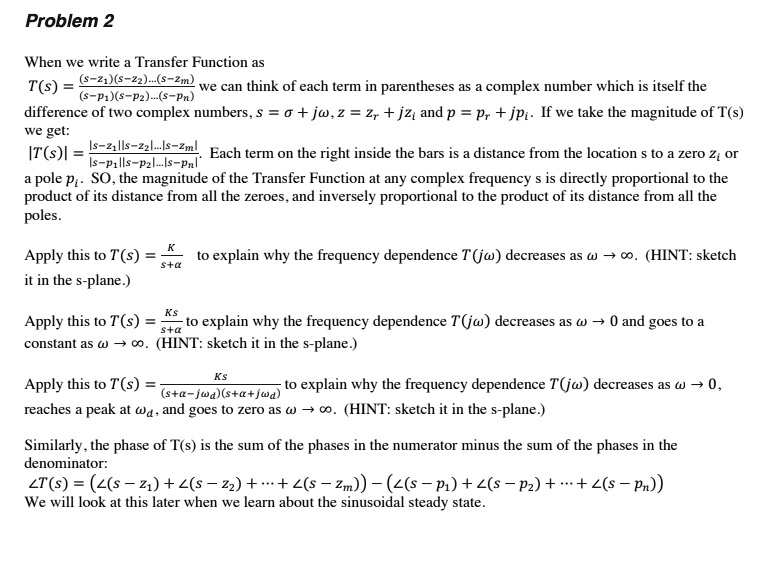
Problem 2 When we write a Transfer Function as (s-p1)(s-p2)..(s-pn) difference of two complex numbers, s = a + bj, z = x + jy and p = pr + jpi. If we take the magnitude of T(s) we get: Each term on the right inside the bars is a distance from the location s to a zero zi or |s-p|ls-p21..|s-pn| a pole p.. SO, the magnitude of the Transfer Function at any complex frequency s is directly proportional to the product of its distance from all the zeroes, and inversely proportional to the product of its distance from all the poles. s+a (HINT: sketch it in the s-plane.) constant as o. (HINT: sketch it in the s-plane.) KS reaches a peak at , and goes to zero as o. (HINT: sketch it in the s-plane.) Similarly, the phase of T(s) is the sum of the phases in the numerator minus the sum of the phases in the denominator: ((d - s)7+.+ (d -s)7+(d -s)) - (z - s)7 +..+(z - s)+(z -s)>)= (s7 We will look at this later when we learn about the sinusoidal steady state.
View Answer
divider