Ace - AI Tutor
Ask Our Educators
Textbooks
My Library
Flashcards
Scribe - AI Notes
Notes & Exams
Download App
Karen Francine Lukoba

Karen F.

Divider

Questions asked

INSTANT ANSWER

EXAMINATION FEBRUARY 1... somas2.uonbi.ac.ke Question 6 Not yet answered Marked out of 6.00 Flag question Determine the inverse of the \[ \left[\begin{array}{ccc} \frac{11}{3} & -\frac{13}{3} & -\frac{11}{3} \\ \frac{13}{3} & -\frac{11}{3} & \frac{11}{3} \\ \frac{11}{3} & \frac{11}{3} & \frac{13}{3} \end{array}\right] \] Previous page Next page Quiz navigation Finish attempt ... Time left 1:47:25

View Answer
divider
INSTANT ANSWER

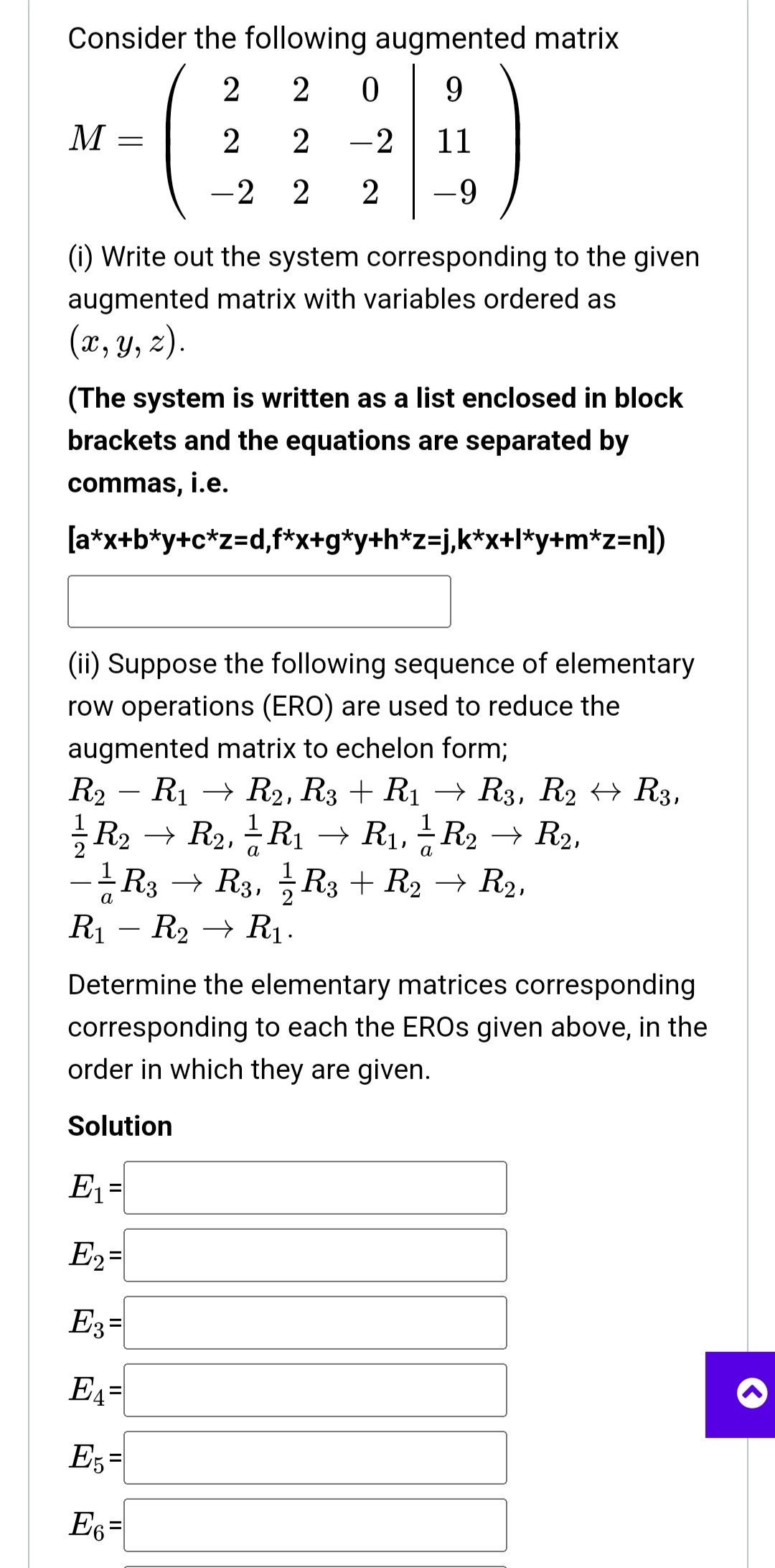
Consider the following augmented matrix \[ M=\left(\begin{array}{ccc|c} 2 & 2 & 0 & 9 \\ 2 & 2 & -2 & 11 \\ -2 & 2 & 2 & -9 \end{array}\right) \] (i) Write out the system corresponding to the given augmented matrix with variables ordered as \( (x, y, z) \). (The system is written as a list enclosed in block brackets and the equations are separated by commas, i.e. \[ \left.\left[a^{\star} x+b^{\star} y+c^{\star} z=d, f^{*} x+g^{\star} y+h^{\star} z=j, k^{\star} x+I^{*} y+m^{\star} z=n\right]\right) \] (ii) Suppose the following sequence of elementary row operations (ERO) are used to reduce the augmented matrix to echelon form; \[ \begin{array}{l} R_{2}-R_{1} \rightarrow R_{2}, R_{3}+R_{1} \rightarrow R_{3}, R_{2} \leftrightarrow R_{3} \\ \frac{1}{2} R_{2} \rightarrow R_{2}, \frac{1}{a} R_{1} \rightarrow R_{1}, \frac{1}{a} R_{2} \rightarrow R_{2} \\ -\frac{1}{a} R_{3} \rightarrow R_{3}, \frac{1}{2} R_{3}+R_{2} \rightarrow R_{2} \\ R_{1}-R_{2} \rightarrow R_{1} . \end{array} \] Determine the elementary matrices corresponding corresponding to each the EROs given above, in the order in which they are given. Solution \[ \begin{array}{l} E_{1}= \\ E_{2}= \\ E_{3}= \\ E_{4}= \\ E_{5}= \\ E_{6}= \end{array} \]
View Answer
divider
ANSWERED

Oswaldo Jiménez verified

Numerade educator

Find the eigenvalues of the matrix A = egin{bmatrix} 5 & 0 & 3 \ -2 & 2 & 0 \ 0 & 0 & 1 end{bmatrix} Characteristic polynomial (type in your answer as a*lambda^2+b*lambda+c, if your polynomial is alambda^2 + blambda + c) is The eigenvalues are (type your answer as [lambda=a, lambda=b] if answer is lambda = a, lambda = b)

View Answer
divider
INSTANT ANSWER

Find the Euclidean distance between \( \vec{u}=(7,4,6,-6) \) and \( \vec{v}=(-7,6,8,8) \) and the cosine of the angle between those vectors. Solution The distance between \( \vec{u} \) and \( \vec{v} \) is The norm of \( \vec{u} \) is The norm of \( \vec{v} \) is The dot product of \( \vec{u} \) and \( \vec{v} \) is Cosine of the angle between the vectors is

View Answer
divider
INSTANT ANSWER

In each part, find the largest possible value for the rank of \( A \) and the smallest possible value for the nullity of \( A \), assuming \( A \) has the indicated order (size). (i) \( 4 \times 5 \) Rank is Nullity is (ii) \( 8 \times 5 \) Rank is Nullity is (iii) \( 5 \times 7 \) Rank is Nullity is

View Answer
divider
INSTANT ANSWER

Consider the matrix \[ \left[\begin{array}{cccccc} 3 & -6 & 0 & 0 & 5 & -1 \\ 0 & 0 & 2 & 0 & 4 & 9 \\ 0 & 0 & 0 & 3 & 7 & 9 \\ 0 & 0 & 0 & 0 & 0 & 0 \end{array}\right] . \] . Suppose that this is an augmented matrix for a system of linear equations which has been reduced by row operations to the given echelon form. Solve the system. If there are free variables, then set the first free one to be \( s \), the second to be \( t \), the third to be \( u \), and so on in alphabetical order. \[ \begin{array}{l} x_{1}=\square \\ x_{2}=\square \\ x_{3}=\square \\ x_{4}=\square \\ x_{5}=\square \end{array} \]

View Answer
divider
INSTANT ANSWER

Find a linear system in the unknowns \( x, y, z \), that corresponds to the given augmented matrix \[ \left[\begin{array}{llll} 3 & 2 & 2 & 3 \\ 2 & 2 & 4 & 5 \\ 2 & 4 & 2 & 5 \end{array}\right] \] Equation 1: Equation 2: Equation 3

View Answer
divider
INSTANT ANSWER

5. (i) Write the expression of Lenz's law. (i) Explain Lenz's law with the help of an experiment. (ii) How does Lenz's law determine direction? (iii) State and explain Faraday's second law of electromagnetic induction. (iv) How does Lenz's law use the right-hand rule?

View Answer
divider
ANSWERED

Breanna Ollech verified

Numerade educator

2. (i) Two equal magnitude charges have ( 19 mathrm{~N} ) force in between them. They have been kept ( 8 mathrm{~cm} ) apart. Find the magnitude of the charges. (ii) Find the magnitude of the electric field when the charge is ( -5 imes 10^{-6} mathrm{C} ) (iii)From (i), where will we find the neutral point for similar charges kept in a line?

View Answer
divider
ANSWERED

Christopher Dzorkpata verified

Numerade educator

A magnetic field of 8.9 T passes perpendicular to a disc with a radius of 5 cm. Find the magnetic flux of the disc.

View Answer
divider