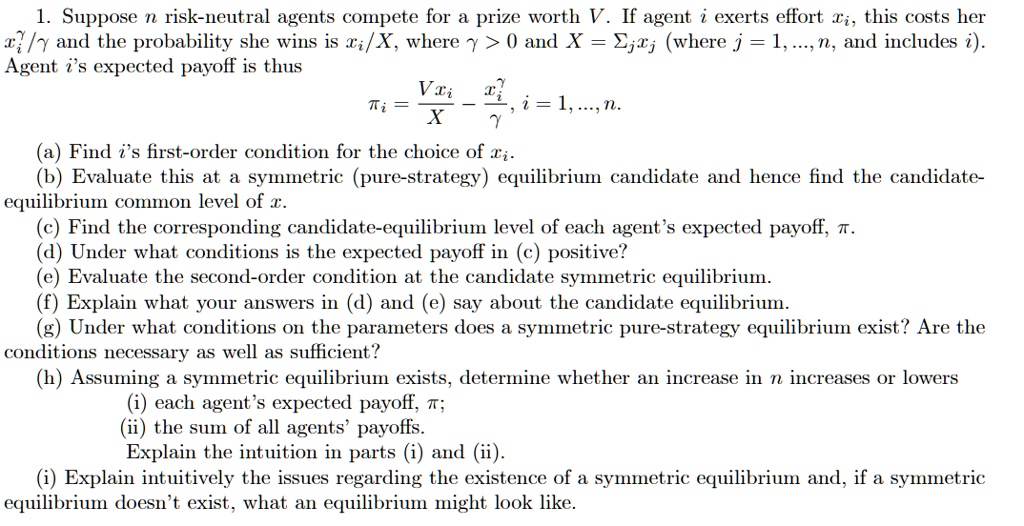
1. Suppose n risk-neutral agents compete for a prize worth V. If agent i exerts effort $x_i$, this costs her $x_i^\gamma / \gamma$ and the probability she wins is $x_i / X$, where $\gamma > 0$ and $X = \sum_j x_j$ (where $j = 1, ..., n$, and includes i). Agent i's expected payoff is thus
$\pi_i = \frac{V x_i}{X} - \frac{x_i^\gamma}{\gamma}$, $i = 1, ..., n$.
(a) Find i's first-order condition for the choice of $x_i$.
(b) Evaluate this at a symmetric (pure-strategy) equilibrium candidate and hence find the candidate-
equilibrium common level of x.
(c) Find the corresponding candidate-equilibrium level of each agent's expected payoff, $\pi$.
(d) Under what conditions is the expected payoff in (c) positive?
(e) Evaluate the second-order condition at the candidate symmetric equilibrium.
(f) Explain what your answers in (d) and (e) say about the candidate equilibrium.
(g) Under what conditions on the parameters does a symmetric pure-strategy equilibrium exist? Are the
conditions necessary as well as sufficient?
(h) Assuming a symmetric equilibrium exists, determine whether an increase in n increases or lowers
(i) each agent's expected payoff, $\pi$;
(ii) the sum of all agents' payoffs.
Explain the intuition in parts (i) and (ii).
(i) Explain intuitively the issues regarding the existence of a symmetric equilibrium and, if a symmetric
equilibrium doesn't exist, what an equilibrium might look like.