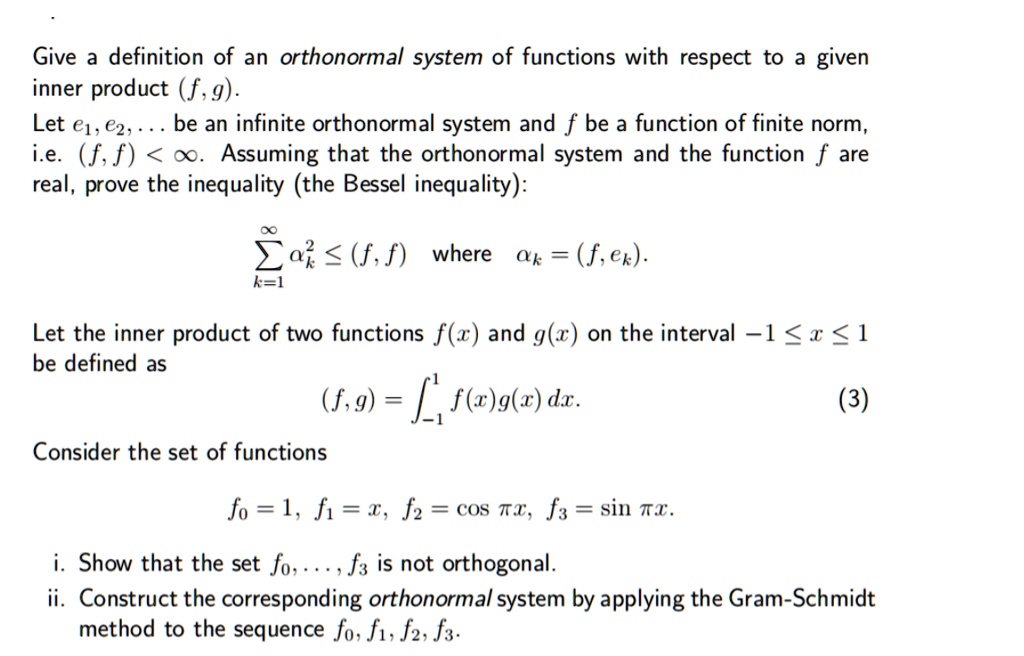
Give a definition of an orthonormal system of functions with respect to a given inner product $(f, g)$.
Let $e_1, e_2, \dots$ be an infinite orthonormal system and $f$ be a function of finite norm, i.e. $(f, f) < \infty$. Assuming that the orthonormal system and the function $f$ are real, prove the inequality (the Bessel inequality):
$\sum_{k=1}^{\infty} \alpha_k^2 \leq (f, f)$ where $\alpha_k = (f, e_k)$.
Let the inner product of two functions $f(x)$ and $g(x)$ on the interval $-1 \leq x \leq 1$ be defined as
$(f, g) = \int_{-1}^{1} f(x)g(x)dx$.
(3)
Consider the set of functions
$f_0 = 1$, $f_1 = x$, $f_2 = \cos \pi x$, $f_3 = \sin \pi x$.
i. Show that the set $f_0, \dots, f_3$ is not orthogonal.
ii. Construct the corresponding orthonormal system by applying the Gram-Schmidt method to the sequence $f_0, f_1, f_2, f_3$.