REPORT
Data and Report Submission - Empirical Formula of Copper Oxide
SUMMARY
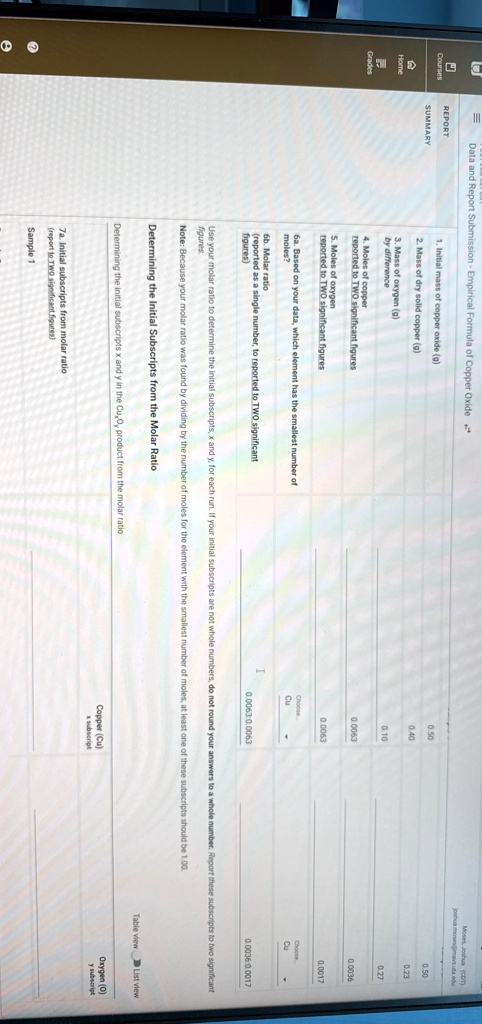
1. Initial mass of copper oxide (g)
2. Mass of dry solid copper (g)
3. Mass of oxygen (g)
by difference
4. Moles of copper
reported to TWO significant figures
5. Moles of oxygen
reported to TWO significant figures
6a. Based on your data, which element has the smallest number of
moles?
6b. Molar ratio
(reported as a single number, to reported to TWO significant
figures)
0.50
0.40
0.10
0.50
0.23
0.27
0.0063
0.0063
Cu
I
0.0063:0.0063
Cu
0.0036
0.0017
0.0036:0.0017
Use your molar ratio to determine the initial subscripts, x and y, for each run. If your initial subscripts are not whole numbers, do not round your answers to a
whole number. Report these subscripts to two significant
figures.
Note: Because your molar ratio was found by dividing by the number of moles for the element with the smallest number of moles, at least one of these subscripts should be 1.00.
Determining the Initial Subscripts from the Molar Ratio
Determining the initial subscripts x and y in the Cu$_x$O$_y$ product from the molar ratio
Copper (Cu)
x subscript
Table view List view
Oxygen (O)
y subscript
7a. Initial subscripts from molar ratio
(report to TWO significant figures)
Sample 1