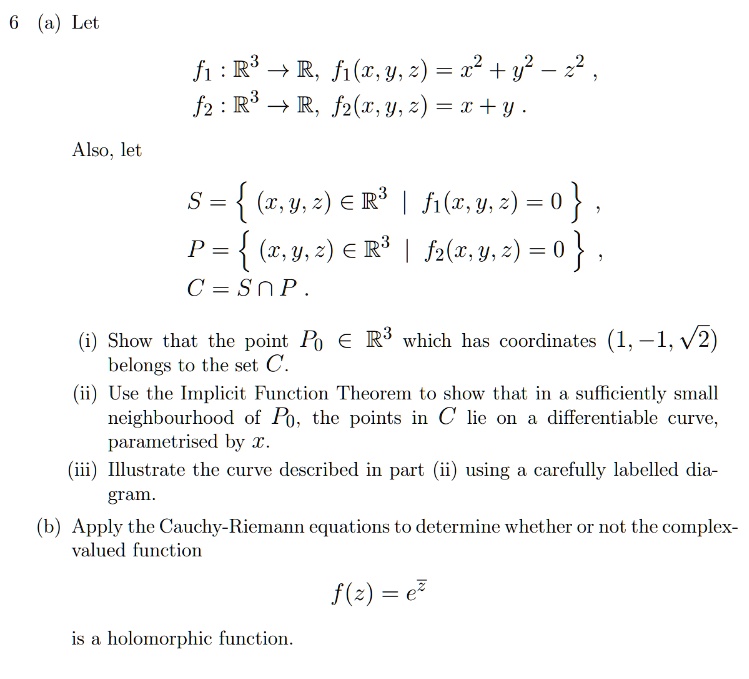
6 (a) Let
f1: R³?R, f1(x, y, z) = x² + y² - z²,
f2: R³ ? R, f2(x, y, z) = x + y .
Also, let
S = { (x, y, z) ? R³ | f1(x, y, z) = 0 },
P = {(x, y, z) ? R³ | f2(x, y, z) = 0 },
C=S?P.
(i) Show that the point P?? R³ which has coordinates (1, -1, ?2)
belongs to the set C.
(ii) Use the Implicit Function Theorem to show that in a sufficiently small
neighbourhood of P?, the points in C lie on a differentiable curve,
parametrised by x.
(iii) Illustrate the curve described in part (ii) using a carefully labelled dia-
gram.
(b) Apply the Cauchy-Riemann equations to determine whether or not the complex-
valued function
f(z) = e<sup>z?</sup>
is a holomorphic function.