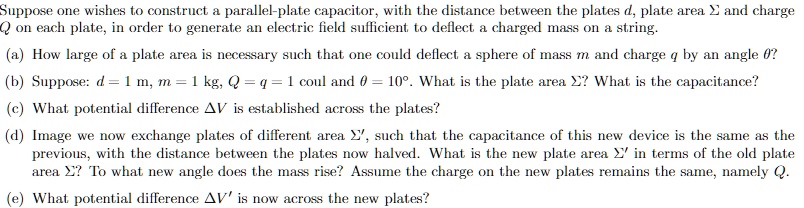
Suppose one wishes to construct a parallel-plate capacitor, with the distance between the plates $d$, plate area $\Sigma$ and charge $Q$ on each plate, in order to generate an electric field sufficient to deflect a charged mass on a string.
(a) How large of a plate area is necessary such that one could deflect a sphere of mass $m$ and charge $q$ by an angle $\theta$?
(b) Suppose: $d = 1$ m, $m = 1$ kg, $Q = q = 1$ coul and $\theta = 10^\circ$. What is the plate area $\Sigma$? What is the capacitance?
(c) What potential difference $\Delta V$ is established across the plates?
(d) Image we now exchange plates of different area $\Sigma'$, such that the capacitance of this new device is the same as the previous, with the distance between the plates now halved. What is the new plate area $\Sigma'$ in terms of the old plate area $\Sigma$? To what new angle does the mass rise? Assume the charge on the new plates remains the same, namely $Q$.
(e) What potential difference $\Delta V'$ is now across the new plates?