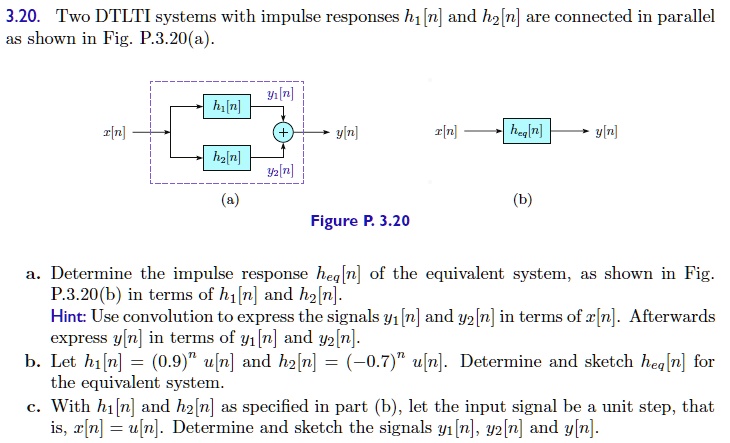
3.20. Two DTLTI systems with impulse responses h1[n] and h2[n] are connected in parallel as shown in Fig. P.3.20(a).
h1[n] r[n] y[n]
------>
h2[n] r[n] y[n]
------>
(a)
(b)
Figure P.3.20
a. Determine the impulse response heg[n] of the equivalent system, as shown in Fig P.3.20(b), in terms of h1[n] and h2[n]. Hint: Use convolution to express the signals y1[n] and y2[n] in terms of x[n]. Afterwards, express y[n] in terms of y1[n] and y2[n].
b. Let h1[n] = (0.9)u[n] and h2[n] = (-0.7)u[n]. Determine and sketch heg[n] for the equivalent system.
c. With h1[n] and h2[n] as specified in part (b), let the input signal be a unit step, that is, x[n] = u[n]. Determine and sketch the signals y1[n], y2[n], and y[n].