Questions asked
Which tactile behavior is commonly observed during reproductive interactions in horses? Biting the neck and withers to stimulate females Flehmen response for pheromone detection Chin resting as a sign of dominance Vocalizations signaling readiness
Use the following to answer question 39: The average score of 100 students taking a statistics final was 70 with a standard deviation of 7. Assuming a normal distribution, what is the probability that students scored less than 60? -0.2271 .0764 0.8929 - 1.14 None of the above
. If a man with widow’s peak QQ has children with a woman with straight hairline qq, what is the probability that their children will have Widow’s peak? Straight hairline?
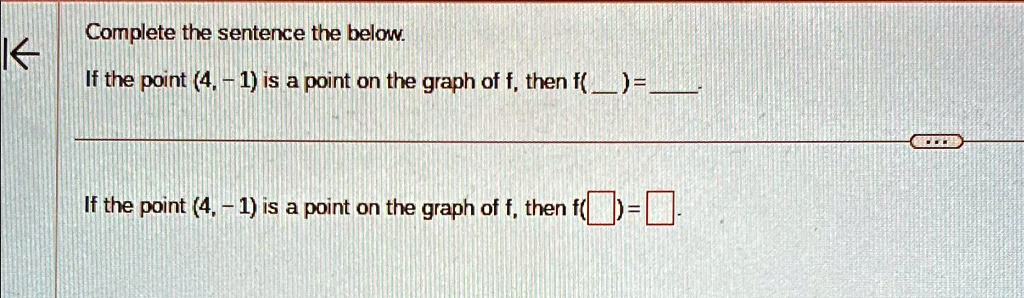
Complete the sentence the below. If the point (4, -1) is a point on the graph of f, then f( ) = If the point (4, -1) is a point on the graph of f, then f( ) =
(2, 1)
Problem 3: Let tan(\alpha) = \frac{3}{4} and cos(\beta) = -\frac{2}{3}, where \alpha is in the first Quadrant and \beta is in the third Quadrant. a. Sketch and complete a right angle triangle for the angle \alpha. b. Sketch and complete a right angle triangle for the angle \beta. c. Find sin(\alpha + \beta). d. Find cos(\alpha + \beta). e. Find tan(\alpha + \beta). f. Find the quadrant containing the angle \alpha + \beta.
In the Moving Average method, how many data points are considered in forecasting the next data point?
A ball on a string swings in a horizontal circle as shown below. The ball has a mass of 0.2 kg, and the string is 0.6 meters long. (The ball is going into the page at the moment shown; the axis of the rotation is the dotted line in the picture) a) ] Draw a force diagram for the ball. b) ] Use Newton's 2nd Law to calculate the acceleration of the ball. Show your work. $F = ma$ $0.6 = 0.2a$ $a = 3$ ) Using the acceleration found in part b), calculate the angular frequency $\omega$ of the ball. What is the direction of $\omega$? $\rightarrow$ down
\(\alpha \neq 0, \beta \neq 0 \text{ and } \gamma \neq 0 \text{ be real nonzero constants, such that } \alpha^2 > \beta^2.\) \\ Solve the system of differential equations \\ \(\frac{d}{dt}u = \begin{pmatrix} \alpha & -\beta & -\beta \\ -\beta & \alpha & -\beta \\ -\beta & -\beta & \alpha \end{pmatrix} u.\) \\ Solve the system of differential equations \\ \(\frac{d}{dt}u = \begin{pmatrix} \alpha & -\beta & -\beta & -\beta \\ -\beta & \alpha & -\beta & -\beta \\ -\beta & -\beta & \alpha & -\beta \\ -\beta & -\beta & -\beta & \alpha \end{pmatrix} u.\) \\ Solve the system of differential equations \\ \(\frac{d}{dt}u = \begin{pmatrix} \alpha & -\beta & \alpha & -\beta \\ -\beta & \alpha & -\beta & \alpha \\ \alpha & -\beta & \alpha & -\beta \\ -\beta & \alpha & -\beta & \alpha \end{pmatrix} u\)
Problem 6.83 - Enhanced - with Feedback Part A On an essentially frictionless, horizontal ice rink, a skater moving at 6.0 m/s encounters a rough patch that reduces her speed by 43% due to a friction force that is 26% of her weight. Use the work-energy theorem to find the length of this rough patch. Express your answer in meters. s =