Ace - AI Tutor
Ask Our Educators
Textbooks
My Library
Flashcards
Scribe - AI Notes
Notes & Exams
Download App
katherine milla

katherine m.

Divider

Questions asked

BEST MATCH

Second-degree price discrimination generates the best outcome for which of the following market structures? O Monopolistic Competition O Oligopoly O Monopoly O Perfect Competition

View Answer
divider
BEST MATCH

Which of these is not a document that you will sign during closing? Moving company contract Deed of trust Closing disclosure Title

View Answer
divider
BEST MATCH

What three conditions must be met before the Sale of Goods Act applies to a transaction? The Sale of Goods Act imposes terms relating to goods matching samples or descriptions and meeting standards of fitness, quality and title. Explain the nature of these implied terms and their effect on the parties. Indicate which terms are conditions and which are warranties and explain the significance of that distinction. Explain the effect on an exemption clause included in a contract that is inconsistent with the terms set out in the Sale of Goods Act. Do you think it is fair for the Competition Bureau to provide immunity to those who engage in price fixing or other actions prohibited by the Competition Act, if they come forward and admit their role?

View Answer
divider
BEST MATCH

When creative destruction occurs: A. New products and new technologies may be created that improve worker productivity, ultimately increasing the growth rate of the economy in the long run. B. No new products or technologies are created, and the lack of innovation will ultimately decrease the growth rate of the economy in the long run. C. It creates new opportunities for some firms but drives others out of the market, and due to the equalizing effect of these two events, economic growth will remain constant. D. Older products - and, often, the firms that produced them - are driven out of the market, which decreases consumer optimism and ultimately decreases economic growth.

View Answer
divider
BEST MATCH

Find the reference angle for 120deg . Find the reference angle for 120

View Answer
divider
BEST MATCH

Which of the following are examples of descriptive analytics? Multiple select question. Data queries Voice command processing Discovering patterns in data Visual reports

View Answer
divider
BEST MATCH

U<sub>AB</sub> = 400 \angle 30<sup>\circ</sup> V

View Answer
divider
BEST MATCH

Find the eigenvalues (real or complex) and bases for the eigenspace of the matrix $A$ $A = \begin{pmatrix} 5 & -2 \\ 1 & 3 \end{pmatrix}$

View Answer
divider
BEST MATCH

Question 2 A 1000N force is applied to a bracket as shown. The part is made from cast iron. Using the Modified Mohr 1 Theory and a factor of safety of 3, specify a safe diameter for the bar. Material ASTM Class 40 Gray Cast iron $S_{ut} = 293.03 \text{ MPa}$, $S_{uc} = 965.27 \text{MPa}$ 200 mm 100 mm d 1000 N Stress Analysis 10 Points Design Region & Stress Element 10 Points Determination of the size 10 Points

View Answer
divider
BEST MATCH

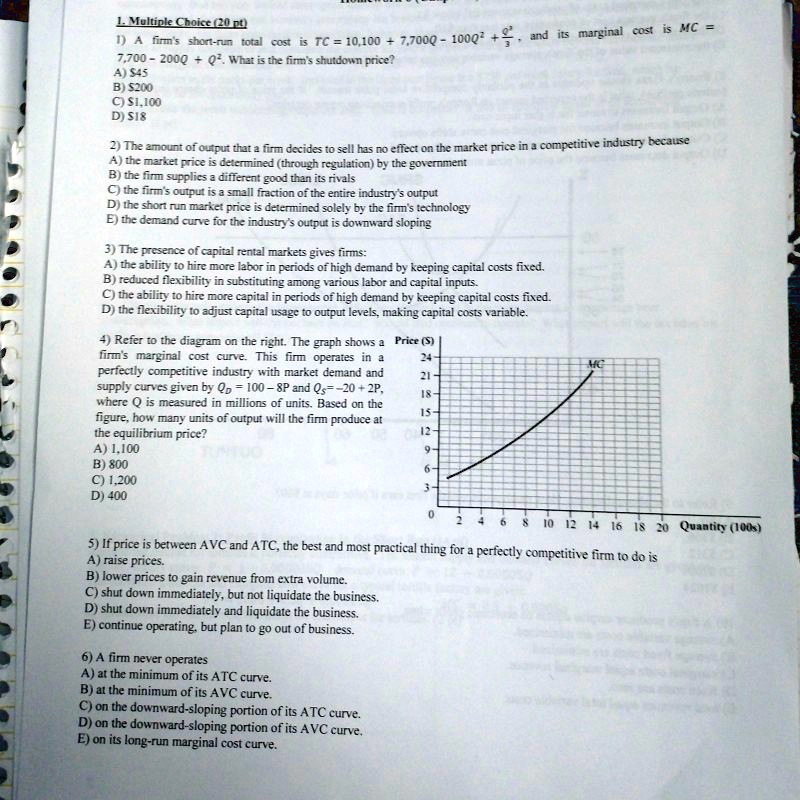
Multiple Choice (20 pt) 7,700-200Q+Q. What is the firm's shutdown price? A $45 B $200 C $1,100 D $18 A. The market price is determined through regulation by the government. B. The firm supplies a different good than its rivals. C. The firm's output is a small fraction of the entire industry's output. D. The short-run market price is determined solely by the firm's technology. E. The demand curve for the industry's output is downward sloping. 3. The presence of capital rental markets gives firms: A. The ability to hire more labor in periods of high demand by keeping capital costs fixed. B. Reduced flexibility in substituting among various labor and capital inputs. C. The ability to hire more capital in periods of high demand by keeping capital costs fixed. D. The flexibility to adjust capital usage to output levels, making capital costs variable. Based on the figure, how many units of output will the firm produce at the equilibrium price? A. 1,100 B. 800 C. 1,200 D. 400 24 21 18 15 12 6 6 5 10 12 14 16 18 20 Quantity 100 A. Raise prices. B. Lower prices to gain revenue from extra volume. C. Shut down immediately, but not liquidate the business. D. Shut down immediately and liquidate the business. E. Continue operating, but plan to go out of business. 6. A firm never operates: A. At the minimum of its ATC curve. B. At the minimum of its AVC curve. C. On the downward-sloping portion of its ATC curve. D. On the downward-sloping portion of its AVC curve. E. On its long-run marginal cost curve.
View Answer
divider