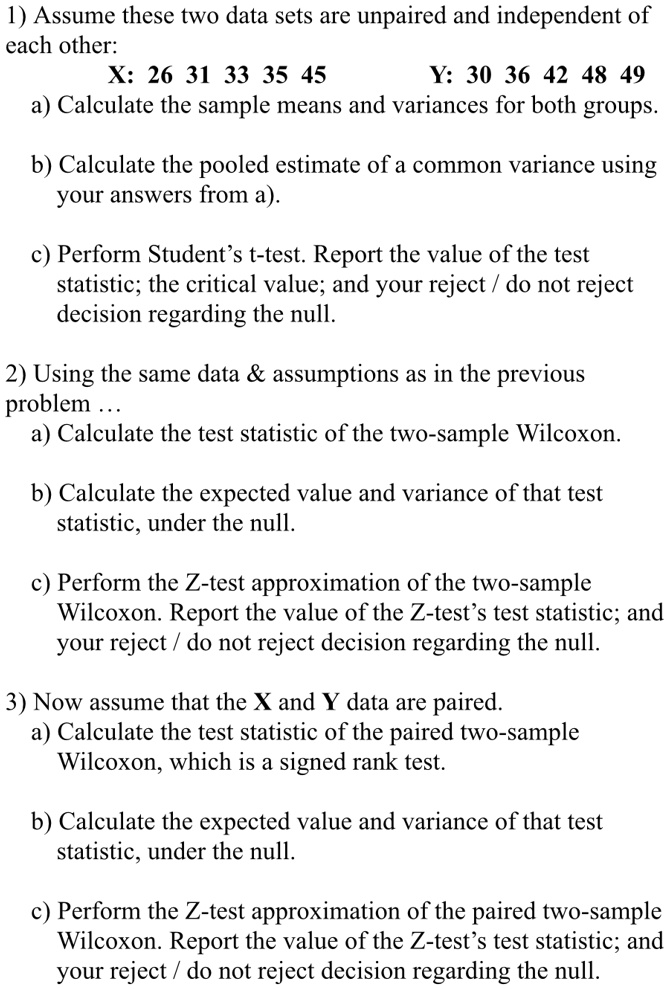
Assume these two data sets are unpaired and independent of each other:
x:263133,3545,Y:3036424849
a) Calculate the sample means and variances for both groups.
b) Calculate the pooled estimate of a common variance using your answers from a).
c) Perform Student's t-test. Report the value of the test statistic; the critical value; and your reject / do not reject decision regarding the null.
Using the same data & assumptions as in the previous problem ...
a) Calculate the test statistic of the two-sample Wilcoxon.
b) Calculate the expected value and variance of that test statistic, under the null.
c) Perform the Z-test approximation of the two-sample Wilcoxon. Report the value of the Z-test's test statistic; and your reject / do not reject decision regarding the null.
Now assume that the x and Y data are paired.
a) Calculate the test statistic of the paired two-sample Wilcoxon, which is a signed rank test.
b) Calculate the expected value and variance of that test statistic, under the null.
c) Perform the Z-test approximation of the paired two-sample Wilcoxon. Report the value of the Z-test's test statistic; and your reject / do not reject decision regarding the null.
l) Assume these two data sets are unpaired and independent of each other: X: 26 31 33 35 45 Y: 30 36 42 48 49 a) Calculate the sample means and variances for both groups
b) Calculate the pooled estimate of a common variance using your answers from a).
c) Perform Student's t-test. Report the value of the test statistic; the critical value; and your reject / do not reject decision regarding the null.
2) Using the same data & assumptions as in the previous problem . a) Calculate the test statistic of the two-sample Wilcoxon.
b) Calculate the expected value and variance of that test statistic, under the null.
c) Perform the Z-test approximation of the two-sample Wilcoxon. Report the value of the Z-test's test statistic; and your reject / do not reject decision regarding the null.
3) Now assume that the X and Y data are paired. a) Calculate the test statistic of the paired two-sample Wilcoxon, which is a signed rank test.
b) Calculate the expected value and variance of that test statistic, under the null.
c) Perform the Z-test approximation of the paired two-sample Wilcoxon. Report the value of the Z-test's test statistic; and your reject / do not reject decision regarding the null.