6.1
L
E
CRU
6.2
i(t)
C
e(t)
L
R
6.3
R1
L
RL
(t)
R2
6.4
R
L
C
e(t)
C
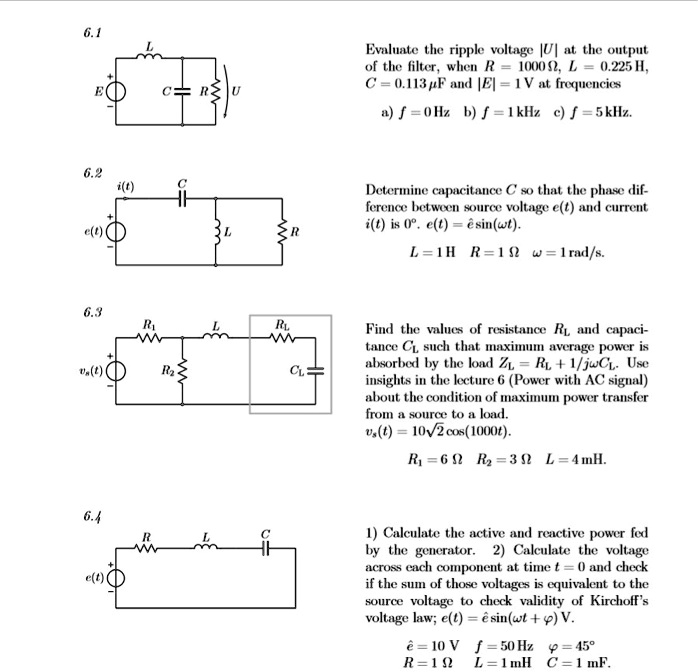
Evaluate the ripple voltage $U$ at the output
of the filter, when $R = 1000 \Omega$, $L = 0.225 H$,
$C = 0.113 \mu F$ and $|E| = 1V$ at frequencies
a) $f = 0 Hz$ b) $f = 1 kHz$ c) $f = 5 kHz$.
Determine capacitance $C$ so that the phase dif-
ference between source voltage $e(t)$ and current
$i(t)$ is $0^\circ$. $e(t) = \hat{e} \sin(\omega t)$.
$L = 1H$ $R = 1 \Omega$ $\omega = 1 rad/s$.
Find the values of resistance $R_1$ and capaci-
tance $C_L$ such that maximum average power is
absorbed by the load $Z_L = R_L + 1/j\omega C_L$. Use
insights in the lecture 6 (Power with AC signal)
about the condition of maximum power transfer
from a source to a load.
$v_s(t) = 10\sqrt{2} \cos(1000t)$.
$R_1 = 6 \Omega$ $R_2 = 3 \Omega$ $L = 4mH$.
1) Calculate the active and reactive power fed
by the generator. 2) Calculate the voltage
across each component at time $t = 0$ and check
if the sum of those voltages is equivalent to the
source voltage to check validity of Kirchoff's
voltage law; $e(t) = \hat{e} \sin(\omega t + \varphi) V$.
$\hat{e} = 10 V$ $f = 50 Hz$ $\varphi = 45^\circ$
$R = 1 \Omega$ $L = 1mH$ $C = 1mF$.