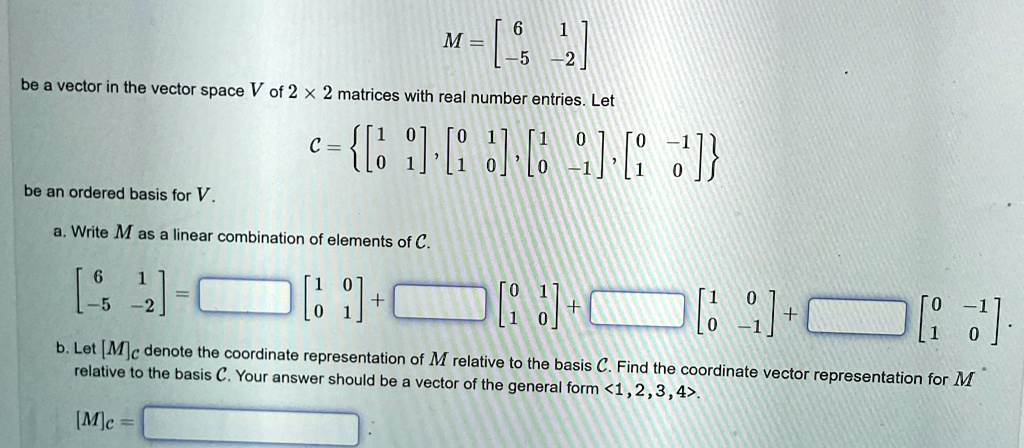
M = \begin{bmatrix} 6 & 1 \\ -5 & -2 \end{bmatrix} \\ be a vector in the vector space V of 2 \times 2 matrices with real number entries. Let \\ \mathcal{C} = \left\{ \begin{bmatrix} 1 & 0 \\ 0 & 1 \end{bmatrix}, \begin{bmatrix} 0 & 1 \\ 1 & 0 \end{bmatrix}, \begin{bmatrix} 1 & 0 \\ 0 & -1 \end{bmatrix}, \begin{bmatrix} 0 & -1 \\ 1 & 0 \end{bmatrix} \right\} \\ be an ordered basis for V. \\ a. Write M as a linear combination of elements of \mathcal{C}. \\ \begin{bmatrix} 6 & 1 \\ -5 & -2 \end{bmatrix} = \boxed{} \begin{bmatrix} 1 & 0 \\ 0 & 1 \end{bmatrix} + \boxed{} \begin{bmatrix} 0 & 1 \\ 1 & 0 \end{bmatrix} + \boxed{} \begin{bmatrix} 1 & 0 \\ 0 & -1 \end{bmatrix} + \boxed{} \begin{bmatrix} 0 & -1 \\ 1 & 0 \end{bmatrix}. \\ b. Let [M]_\mathcal{C} denote the coordinate representation of M relative to the basis \mathcal{C}. Find the coordinate vector representation for M \\ relative to the basis \mathcal{C}. Your answer should be a vector of the general form <1,2,3,4>. \\ [M]_\mathcal{C} = \boxed{ }