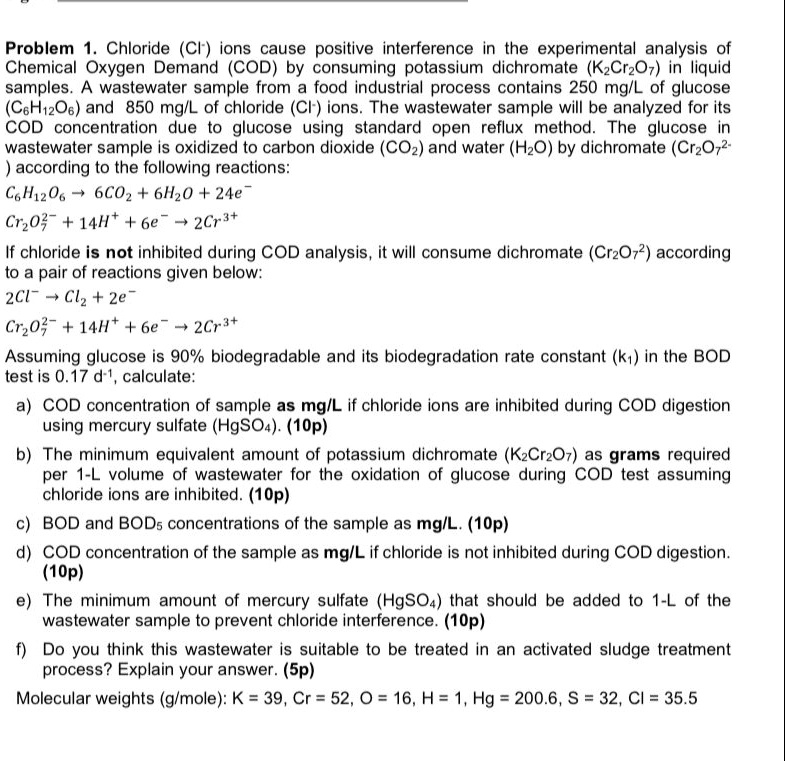
Texts: Problem 1. Chloride (Cl) ions cause positive interference in the experimental analysis of Chemical Oxygen Demand (COD) by consuming potassium dichromate (K2Cr2O7) in liquid samples. A wastewater sample from a food industrial process contains 250 mg/L of glucose (C6H12O6) and 850 mg/L of chloride (Cl-) ions. The wastewater sample will be analyzed for its COD concentration due to glucose using the standard open reflux method. The glucose in the wastewater sample is oxidized to carbon dioxide (CO2) and water (H2O) by dichromate (Cr2O7) according to the following reactions:
C6H12O6 + 6O2 → 6CO2 + 6H2O
If chloride is not inhibited during COD analysis, it will consume dichromate (Cr2O7) according to a pair of reactions given below:
2Cl- + 2Cr2O7^2- + 14H+ → 2Cr3+ + 7H2O + 2Cl2
Assuming glucose is 90% biodegradable and its biodegradation rate constant (k) in the BOD test is 0.17 d^-1, calculate:
a) COD concentration of the sample as mg/L if chloride ions are inhibited during COD digestion using mercury sulfate (HgSO4). (10p)
b) The minimum equivalent amount of potassium dichromate (K2Cr2O7) as grams required per 1-L volume of wastewater for the oxidation of glucose during COD test assuming chloride ions are inhibited. (10p)
c) BOD and BOD5 concentrations of the sample as mg/L. (10p)
d) COD concentration of the sample as mg/L if chloride is not inhibited during COD digestion. (10p)
e) The minimum amount of mercury sulfate (HgSO4) that should be added to 1-L of the wastewater sample to prevent chloride interference. (10p)
f) Do you think this wastewater is suitable to be treated in an activated sludge treatment process? Explain your answer. (5p)
Molecular weights (g/mole): K=39, Cr=52, O=16, H=1, Hg=200.6, S=32, Cl=35.5