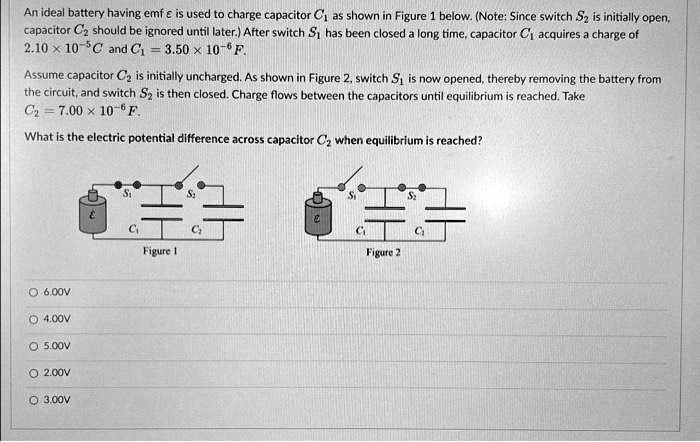
An ideal battery having emf \( \varepsilon \) is used to charge capacitor \( C_1 \) as shown in Figure 1 below. (Note: Since switch \( S_2 \) is initially open, capacitor \( C_2 \) should be ignored until later.) After switch \( S_1 \) has been closed a long time, capacitor \( C_1 \) acquires a charge of \( 2.10 \times 10^{-5} C \) and \( C_1 = 3.50 \times 10^{-6} F \).
Assume capacitor \( C_2 \) is initially uncharged. As shown in Figure 2, switch \( S_1 \) is now opened, thereby removing the battery from the circuit, and switch \( S_2 \) is then closed. Charge flows between the capacitors until equilibrium is reached. Take \( C_2 = 7.00 \times 10^{-6} F \).
What is the electric potential difference across capacitor \( C_2 \) when equilibrium is reached?
\( \bigcirc \) 6.00V
\( \bigcirc \) 4.00V
\( \bigcirc \) 5.00V
\( \bigcirc \) 2.00V
\( \bigcirc \) 3.00V