Problem 2
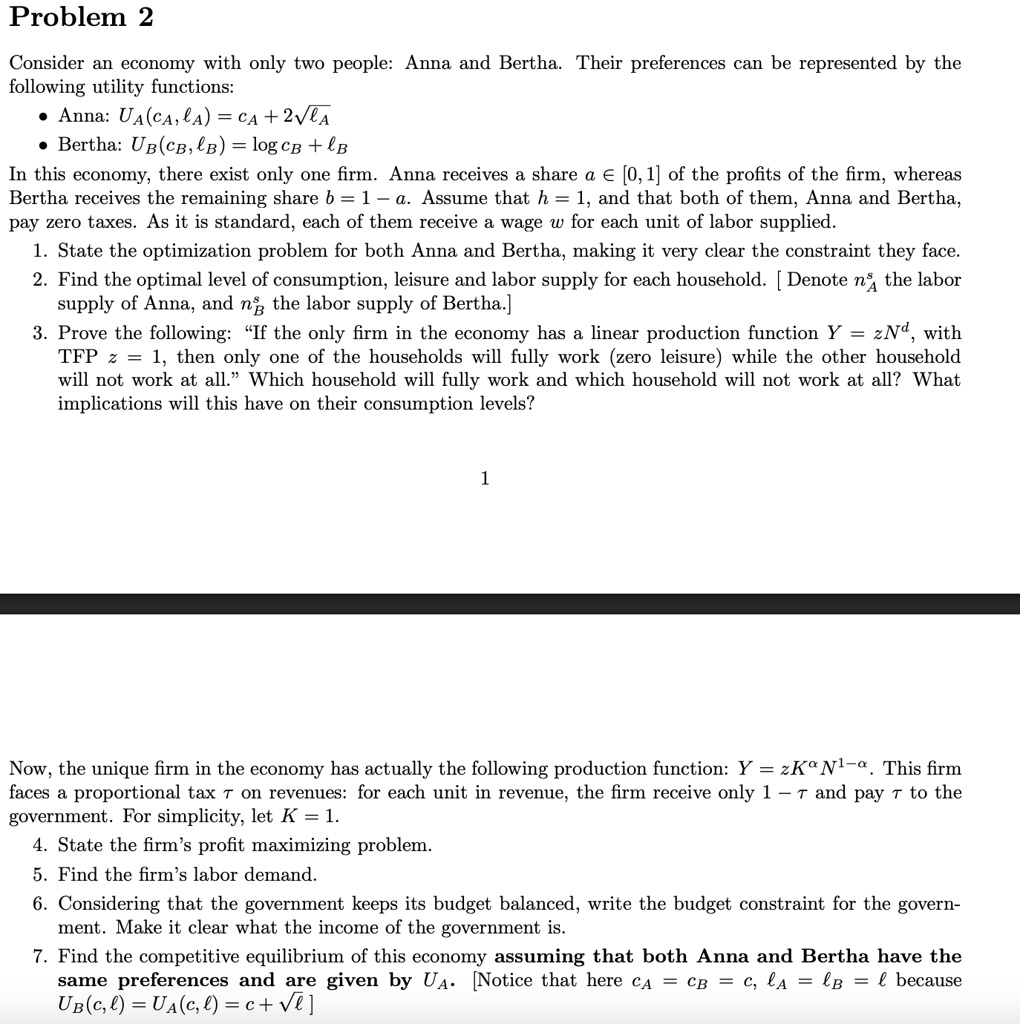
Consider an economy with only two people: Anna and Bertha. Their preferences can be represented by the
following utility functions:
Anna: U_(A)(c_(A),l_(A))=c_(A)+2\sqrt(l_(A))
Bertha: U_(B)(c_(B),l_(B))=logc_(B)+l_(B)
In this economy, there exist only one firm. Anna receives a share ain[0,1] of the profits of the firm, whereas
Bertha receives the remaining share b=1-a. Assume that h=1, and that both of them, Anna and Bertha,
pay zero taxes. As it is standard, each of them receive a wage wn_(A)^(s) the labor
supply of Anna, and n_(B)^(s) the labor supply of Bertha.Y=zN^(d), with
TFP z=1, then only one of the households will fully work (zero leisure) while the other household
will not work at all." Which household will fully work and which household will not work at all? What
implications will this have on their consumption levels?
Now, the unique firm in the economy has actually the following production function: Y=zK^(\alpha )N^(1-\alpha ). This firm
faces a proportional tax \tau on revenues: for each unit in revenue, the firm receive only 1-\tau and pay \tau to the
government. For simplicity, let K=1.
State the firm's profit maximizing problem.
Find the firm's labor demand.
Considering that the government keeps its budget balanced, write the budget constraint for the govern-
ment. Make it clear what the income of the government is.
Find the competitive equilibrium of this economy assuming that both Anna and Bertha have the
same pref