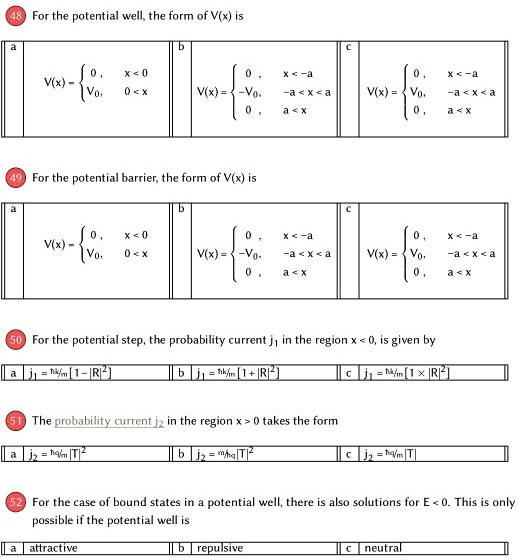
48 For the potential well, the form of V(x) is
a
b
c
$V(x) = \begin{cases} 0, & x < 0\\ -V_0, & 0 < x \end{cases}$
$V(x) = \begin{cases} 0, & x < -a\\ -V_0, & -a < x < a\\ 0, & a < x \end{cases}$
$V(x) = \begin{cases} 0, & x < -a\\ V_0, & -a < x < a\\ 0, & a < x \end{cases}$
49 For the potential barrier, the form of V(x) is
a
b
c
$V(x) = \begin{cases} 0, & x < 0\\ -V_0, & 0 < x \end{cases}$
$V(x) = \begin{cases} 0, & x < -a\\ -V_0, & -a < x < a\\ 0, & a < x \end{cases}$
$V(x) = \begin{cases} 0, & x < -a\\ V_0, & -a < x < a\\ 0, & a < x \end{cases}$
50 For the potential step, the probability current $j_1$ in the region $x < 0$, is given by
a $j_1 = \frac{\hbar k}{m} [1 - |R|^2]$
b $j_1 = \frac{\hbar k}{m} [1 + |R|^2]$
c $j_1 = \frac{\hbar k}{m} [1 \times |R|^2]$
51 The probability current $j_2$ in the region $x > 0$ takes the form
a $j_2 = \frac{\hbar v}{m} |T|^2$
b $j_2 = \frac{m}{\hbar q} |T|^2$
c $j_2 = \frac{\hbar q}{m} |T|$
52 For the case of bound states in a potential well, there is also solutions for $E < 0$. This is only
possible if the potential well is
a attractive
b repulsive
c neutral