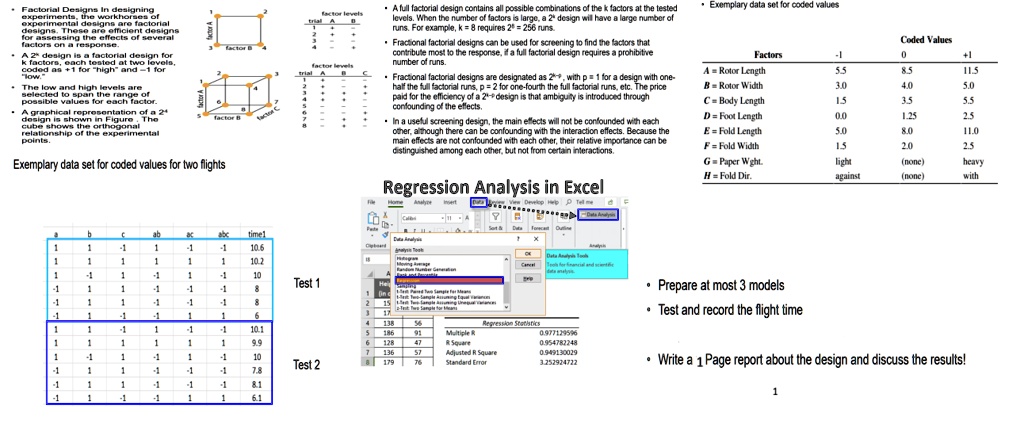
Factorial Designs In designing
experiments, the workhorses of
experimental designs are factorial designs. These are efficient designs
for assessing the effects of several
factors on a response.
A 2^(k) design is a factorial design for
k factors, each tested at two levels.
The low and high levels are
selected to span the range of
possible values for each factor.
A graphical representation of a 2^(4)
design is shown in Figure,
cube shows the orthogonal
points.
Exemplary data set for coded values for two flights
A full factorial design contains all possible combinations of the k factors at the tested
levels. When the number of factors is large, a 2^(k) design will have a large number of
runs. For example, k=8 requires 2^(8)=256 runs.
Fractional factorial designs can be used for screening to find the factors that
contribute most to the response, if a full factorial design requires a prohibitive
number of runs.
Fractional factorial designs are designated as 2^(k-p), with p=1 for a design with one-
half the full factorial runs, p=2 for one-fourth the full factorial runs, etc. The price
paid for the efficiency of a 2^(k-p) design is that ambiguity is introduced through
confounding of the effects.
In a useful screening design, the main effects will not be confounded with each
other, although there can be confounding with the interaction effects. Because the
main effects are not confounded with each other, their relative importance can be
distinguished among each other, but not from certain interactions.
Regression Analysis in Excel
Test 1
Test 2
Exemplary data set for coded values
Prepare at most 3 models
Test and record the flight time
Write a 1 Page report about the design and discuss the results!
A full factorial design contains all possible combinations of the k factors at the tested levels. When the number of factors is large, a 2^(k) design will have a large number of runs. For example, k = 8 requires 2^(8)=256 runs. Fractional factorial designs can be used for screening to find the factors that contribute most to the response, if a full factorial design requires a prohibitive number of runs. Fractional factorial designs are designated as 2^(k-p), with p=1 for a design with one half the full factorial runs, p=2 for one-fourth the full factorial runs, etc. The price paid for the efficiency of a 2^(k-p) design is that ambiguity is introduced through confounding of the effects. In a useful screening design, the main effects will not be confounded with each other, although there can be confounding with the interaction effects. Because the main effects are not confounded with each other, their relative importance can be distinguished among each other, but not from certain interactions.
Exemplary data set for coded values
designs. These are efficient design
Coded Values 0 +1 8.5 11.5 4.0 5.0 3.5 5.5 1.25 2.5 8.0 11.0 2.0 2.5 (none) heavy (none) with
Factors A = Rotor Length = Rotor Width C = Body Length D= Foot Length E = Fold Length F = Fold Width G=Paper Wght. H = Fold Dir.
-1 5.5 3.0 1.5 0.0 5.0 1.5 light against
coded as +1 to
The low and high levels
of a 2
relationship of the experimental points
Exemplary data set for coded values for two flights
Regression Analysis in Excel Test
time 10.6 10.2 10 8
-1 1 1 1 . -1
-1
-1
1
1 -1 -1 -1
1 1 1
-1 -1 1
-1 -1
Test 1
Prepare at most 3 models
-1 -1
Test and record the flight time
6
1 1 7.
-1 1 1 1 1
1 1 -1
-1
-1
10.1 66 10 7.8 8.1 6.1
Multiple R R Square Adjusted R Square Standard Error
Statistics 0.977129596 0.954782248 0.949130029 3.252924722
6 128 136 179
1 -1 -1 1
Test 2
Write a Page report about the design and discuss the results
-1 -1 -1
-1 -1
1 1
1