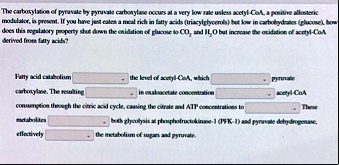
The carboxylation of pyruvate by pyruvate carboxylase occurs at a very low rate unless acetyl-CoA, a positive allosteric modulator, is present. If you have just eaten a meal rich in fatty acids (triacylglycerols) but low in carbohydrates (glucose), how does this regulatory property shut down the oxidation of glucose to CO₂ and H₂O but increase the oxidation of acetyl-CoA derived from fatty acids?
Fatty acid catabolism [BLANK] the level of acetyl-CoA, which [BLANK] pyruvate carboxylase. The resulting [BLANK] in oxaloacetate concentration [BLANK] acetyl-CoA consumption through the citric acid cycle, causing the citrate and ATP concentrations to [BLANK]. These metabolites [BLANK] both glycolysis at phosphofructokinase-1 (PFK-1) and pyruvate dehydrogenase, effectively [BLANK] the metabolism of sugars and pyruvate.