Ace - AI Tutor
Ask Our Educators
Textbooks
My Library
Flashcards
Scribe - AI Notes
Notes & Exams
Download App
kayla casals

kayla c.

Divider

Questions asked

BEST MATCH

a student is asked to determine the molar enthalpy of neutralization combines 1.0 M HCl and 1.00 M NaOH

View Answer
divider
BEST MATCH

chemist, add 0.40 L of a 0.0 246M potassium dichromate solution to a reaction flask. Calculate the mass in grams of potassium dichromate. The chemist is added to the flask. Be sure your answer has a number of significant digits.

View Answer
divider
BEST MATCH

After an action potential, which channel opens to return the membrane potential back to resting? O voltage gated Cl- channels O voltage gates K+ channels O voltage gated Na+ channels O voltage gated Ca2+ channels

View Answer
divider
BEST MATCH

What is an antigen?. O Any molecule that triggers an immune response O A molecule produced during an immune response O A molecule that causes red blood cell agglutination

View Answer
divider
BEST MATCH

How was George Washington elected as president? By the electoral college By land-owning male citizens By all American citizens

View Answer
divider
BEST MATCH

Write an equation of the tangent plane to the ellipsoid \( (x-2)^{2}+6 y^{2}+4 z^{2}=28 \) at the point \( M(2,2,1) \). Answer: \( \square \)

View Answer
divider
BEST MATCH

2. Determine $V_x$ in the circuit below $20 \Omega$ $+60\angle0^\circ V$ $29.2\angle-166^\circ V$ $+$ $V_x$ $-$ $20 \Omega$ $0.2V_x$ $j10 \Omega$

View Answer
divider
BEST MATCH

Google Classroom Determine the intercepts of the line. Do not round your answers. 3x+2y=5

View Answer
divider
BEST MATCH

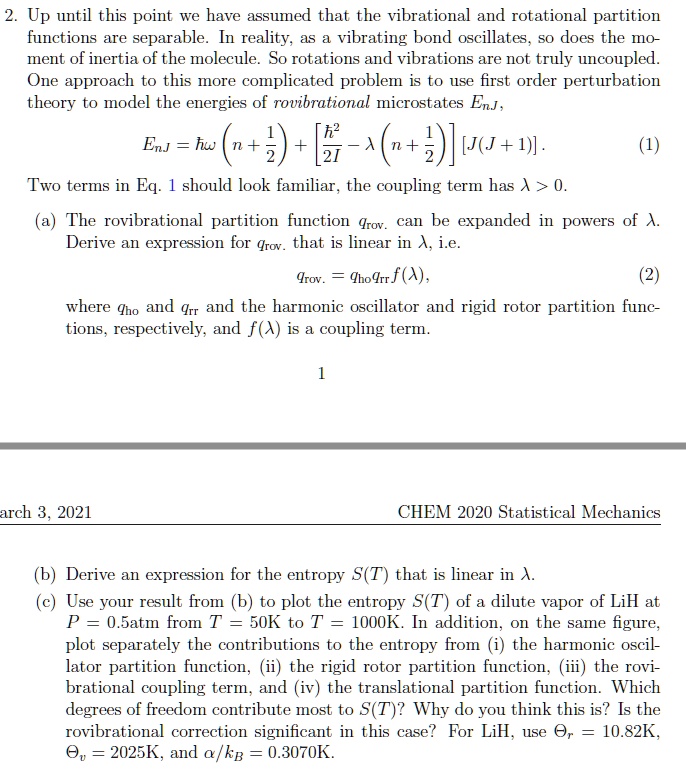
Up until this point, we have assumed that the vibrational and rotational partition functions are separable. In reality, as a vibrating bond oscillates, so does the moment of inertia of the molecule. So rotations and vibrations are not truly uncoupled. One approach to this more complicated problem is to use first-order perturbation theory to model the energies of rovibrational microstates, EnJ: EnJ = hw(n + [J(J+1)]) (1) Two terms in Eq. 1 should look familiar, the coupling term has > 0. (a) The rovibrational partition function, qrov, can be expanded in powers of X. Derive an expression for qrov that is linear in A, i.e. qrov = qho * qrr * f(A) (2) where qho and qrr are the harmonic oscillator and rigid rotor partition functions, respectively, and f(A) is a coupling term. (b) Derive an expression for the entropy S(T) that is linear in A. (c) Use your result from (b) to plot the entropy S(T) of a dilute vapor of LiH at P = 0.5 atm from T = 50K to T = 1000K. In addition, on the same figure, plot separately the contributions to the entropy from (i) the harmonic oscillator partition function, (ii) the rigid rotor partition function, (iii) the rovibrational coupling term, and (iv) the translational partition function. Which degrees of freedom contribute most to S(T)? Why do you think this is? Is the rovibrational correction significant in this case? For LiH, use Or = 10.82K, O = 2025K, and a/kp = 0.3070K.
View Answer
divider
BEST MATCH

A driven oscillator has a natural frequency $\omega_0$ of 10 rad/s, a Q-value of 25 its equation of motion given by $\frac{d^2x}{dt^2} + \gamma \frac{dx}{dt} + \omega_0^2 x = 20 \cos(20 \ t)$ The amplitude of the steady state oscillations of the mass

View Answer
divider