Chapter 8 Exercises
Reading Check
?
Short Answer: Please provide brief, concise answers to the following questions.
1. What are the two ways in which a screening test can be wrong?
2. What is a false positive rate?
3. What is sensitivity in terms of the false negative rate?
4. Give two reasons why the "99% accuracy" claims listed on home pregnancy tests might
be misleading.
5. In what sense are positivity predictive value and sensitivity similar?
6. Regarding the ImPACT example, how many athletes studied were not in fact concussed?
7. Regarding the ImPACT example, how many athletes studied did the screening test find to be
concussed?
8. Regarding the Beck Inventory example, in what percentage of cases did the screening test
make the right decision?
9. Regarding the Field Sobriety Test example, what was the sensitivity when a cutoff of 4 was
used?
10. What is the larger purpose of Bayes' Rule being introduced in this chapter?
Beyond the Numbers
1. Grading the FOB
The Fecal Occult Blood (FOB) test is used to screen people for bowel cancer. As expected, if it
comes up positive, then you are told you likely have bowel cancer. If it comes up negative, you
are told you are likely okay. So the outcome is dichotomous: either a "thumbs up" or a "thumbs
down." A study involving 203 people was designed to assess how well the FOB works. Two things
were recorded for each participant in the study: whether the FOB said they had bowel cancer
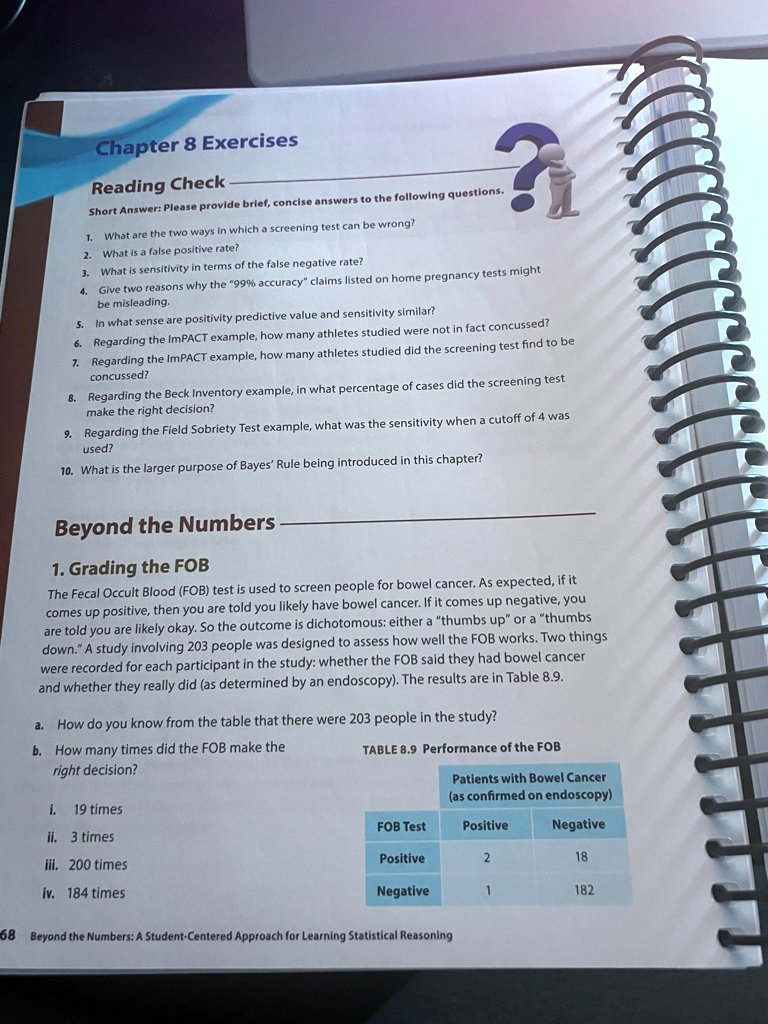
and whether they really did (as determined by an endoscopy). The results are in Table 8.9.
a. How do you know from the table that there were 203 people in the study?
b. How many times did the FOB make the
right decision?
i. 19 times
ii. 3 times
iii. 200 times
iv. 184 times
TABLE 8.9 Performance of the FOB
Patients with Bowel Cancer
(as confirmed on endoscopy)
FOB Test
Positive
Negative
Positive
2
18
Negative
1
182
68 Beyond the Numbers: A Student-Centered Approach for Learning Statistical Reasoning