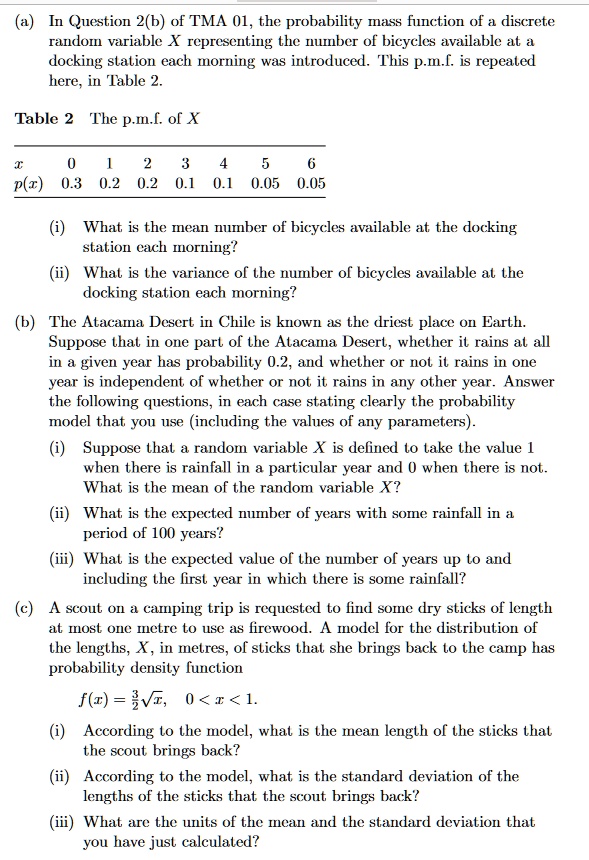
(a) In Question 2(b) of TMA 01, the probability mass function of a discrete
random variable x representing the number of bicycles available at a
docking station each morning was introduced. This p.m.f. is repeated
here, in Table 2.
Table 2 The p.m.f. of x
(i) What is the mean number of bicycles available at the docking
station each morning?
(ii) What is the variance of the number of bicycles available at the
docking station each morning?
(b) The Atacama Desert in Chile is known as the driest place on Earth.
Suppose that in one part of the Atacama Desert, whether it rains at all
in a given year has probability 0.2 , and whether or not it rains in one
year is independent of whether or not it rains in any other year. Answer
the following questions, in each case stating clearly the probability
model that you use (including the values of any parameters).
(i) Suppose that a random variable x is defined to take the value 1
when there is rainfall in a particular year and 0 when there is not.
What is the mean of the random variable x ?
(ii) What is the expected number of years with some rainfall in a
period of 100 years?
(iii) What is the expected value of the number of years up to and
including the first year in which there is some rainfall?
(c) A scout on a camping trip is requested to find some dry sticks of length
at most one metre to use as firewood. A model for the distribution of
the lengths, x, in metres, of sticks that she brings back to the camp has
probability density function
f(x)=(3)/(2)sqrt(x),0
(i) According to the model, what is the mean length of the sticks that
the scout brings back?
(ii) According to the model, what is the standard deviation of the
lengths of the sticks that the scout brings back?
(iii) What are the units of the mean and the standard deviation that
you have just calculated?
(a) In Question 2(b) of TMA 01, the probability mass function of a discrete random variable X representing the number of bicycles available at a docking station each morning was introduced. This p.m.f. is repeated here, in Table 2.
Table 2The p.m.f. of X
x 0 1 2 3 4 5 6 p(x) 0.3 0.2 0.2 0.1 0.1 0.05 0.05
(i) What is the mean number of bicycles available at the docking station cach morning?
(ii) What is the variance of the number of bicycles available at the docking station each morning?
(b) The Atacama Desert in Chile is known as the driest place on Earth. Suppose that in one part of the Atacama Desert, whether it rains at all in a given year has probability 0.2, and whether or not it rains in one year is independent of whether or not it rains in any other year. Answer the following questions, in each case stating clearly the probability model that you use (including the values of any parameters)
(i) Suppose that a random variable X is defined to take the value 1 when there is rainfall in a particular year and 0 when there is not. What is the mean of the random variable X?
(ii) What is the expected number of years with some rainfall in a period of 100 years? (iii) What is the expected value of the number of years up to and including the first year in which there is some rainfall?
c)A scout on a camping trip is requested to find some dry sticks of length at most one metre to use as firewood. A model for the distribution of the lengths, X, in metres, of sticks that she brings back to the camp has probability density function
f(=Vx0<x<1.
According to the model, what is the mean length of the sticks that the scout brings back?
(ii According to the model, what is the standard deviation of the lengths of the sticks that the scout brings back?
(iii) What are the units of the mean and the standard deviation that you have just calculated?