Question 28
1 pts
Solve the problem.
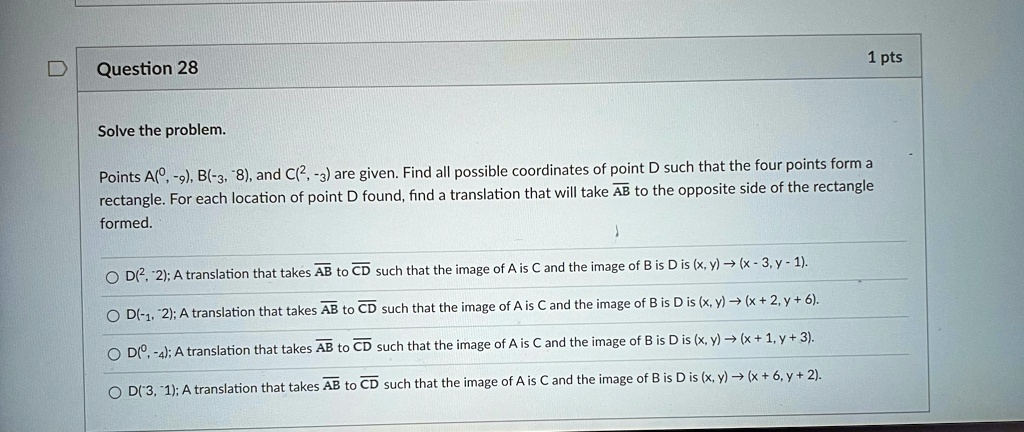
Points A(^(0),-9),B(-3,-8), and C(^(2),-3) are given. Find all possible coordinates of point D such that the four points form a rectangle. For each location of point D found, find a translation that will take /bar (AB) to the opposite side of the rectangle formed.
D(^(2),-2); A translation that takes /bar (AB) to /bar (CD) such that the image of A is C and the image of B is D is (x,y)->(x-3,y-1).
D(-1,-2); A translation that takes /bar (AB) to /bar (CD) such that the image of A is C and the image of B is D is (x,y)->(x+2,y+6).
D(^(0),-4); A translation that takes /bar (AB) to /bar (CD) such that the image of A is C and the image of B is D is (x,y)->(x+1,y+3).
◻ D(3,-1); A translation that takes /bar (AB) to /bar (CD) such that the image of A is C and the image of B is D is (x,y)->(x+6,y+2).
1pts
Question 28
Solve the problem
Points A0,-g),B(-3,8, and C2,-3) are given.Find all possible coordinates of point D such that the four points form a rectangle.For each location of point D found,find a translation that will take AB to the opposite side of the rectangle formed.
O D2,-2);A translation that takes AB toCD such that the image of A is C and the image of B is D is (x,y)x-3, y -1). O D(-1,2); A translation that takes AB to CD such that the image of A is Cand the image of B is D is x, y) (x+ 2, y + 6). O D(0, -4); A translation that takes AB to CD such that the image of A is C and the image of B is D is(x,y)x+ 1, y+ 3. O D(3,1); A translation that takes AB to CD such that the image of A is C and the image of B is D is x, y) (x + 6, y + 2).