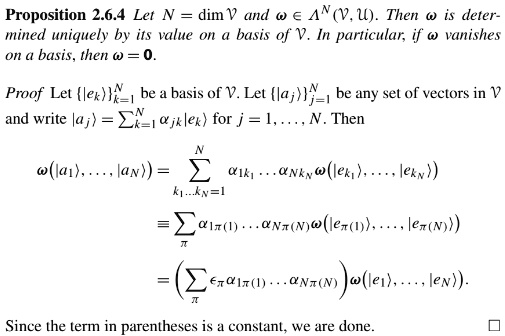
Proposition 2.6.4 Let $N = \text{dim } V$ and $\omega \in \Lambda^N(V, \mathbb{U})$. Then $\omega$ is determined uniquely by its value on a basis of $V$. In particular, if $\omega$ vanishes on a basis, then $\omega = 0$.
Proof Let ${\{e_k\}}_{k=1}^N$ be a basis of $V$. Let ${\{a_j\}}_{j=1}^N$ be any set of vectors in $V$ and write $a_j = \sum_{k=1}^N \alpha_{jk} e_k$ for $j = 1, \dots, N$. Then
$\omega(a_1, \dots, a_N) = \sum_{k_1, \dots, k_N = 1}^N \alpha_{1k_1} \dots \alpha_{Nk_N} \omega(e_{k_1}, \dots, e_{k_N})
= \sum_{\pi} \alpha_{1\pi(1)} \dots \alpha_{N\pi(N)} \omega(e_{\pi(1)}, \dots, e_{\pi(N)})
= \left(\sum_{\pi} \epsilon_\pi \alpha_{1\pi(1)} \dots \alpha_{N\pi(N)}\right) \omega(e_1, \dots, e_N)$.
Since the term in parentheses is a constant, we are done.