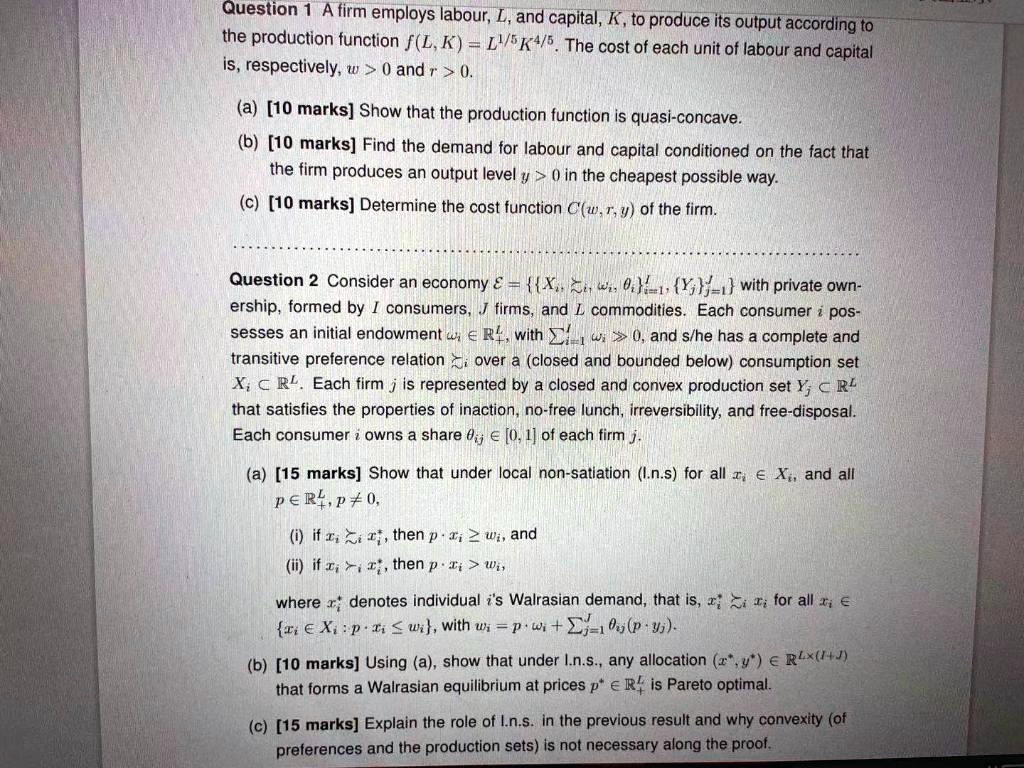
A firm employs labor, L, and capital, K, to produce its output according to the production function f(L,K) = 5K^(4/5). The cost of each unit of labor and capital is, respectively, w > 0 and r > 0.
a. [10 marks] Show that the production function is quasi-concave.
b. [10 marks] Find the demand for labor and capital conditioned on the fact that the firm produces an output level y > 0 in the cheapest possible way.
c. [10 marks] Determine the cost function C(w,T(y)) of the firm.
Question 2: Consider an economy with private ownership formed by consumers, firms, and commodities. Each consumer i possesses a transitive preference relation over a closed and bounded below consumption set X. Each firm j is represented by a closed and convex production set Y that satisfies the properties of inaction, no-free lunch irreversibility, and free-disposal. Each consumer i owns a share [01] of each firm.
a. [15 marks] Show that under local non-satiation (l.n.s) for all x in X and all p in R^E, if x is weakly preferred to y, then p*x >= p*y and (if x is strictly preferred to y, then p*x > p*y).
b. [10 marks] Using part a, show that under l.n.s, any allocation y in R^x+ that forms a Walrasian equilibrium at prices p* is Pareto optimal.
c. [15 marks] Explain the role of l.n.s in the previous result and why convexity of preferences and the production sets is not necessary along the proof.