5 Energy and Angular Momentum
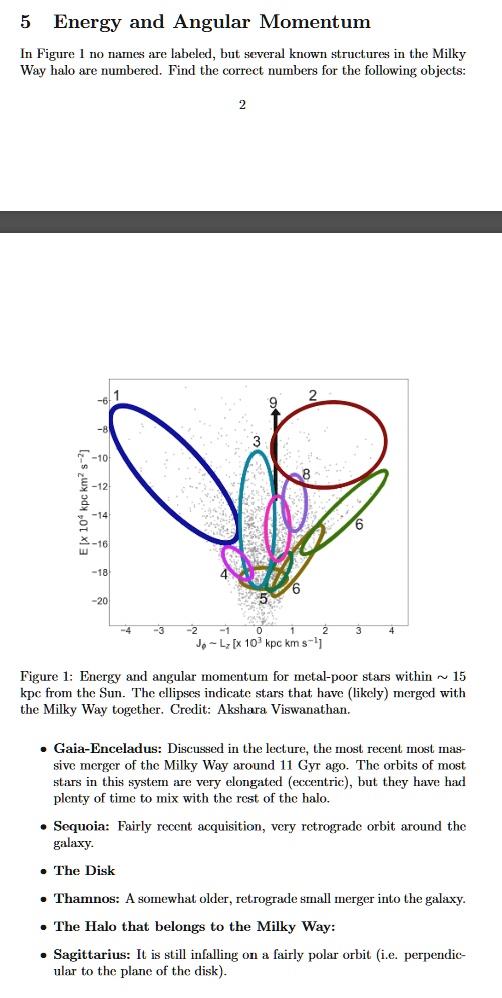
In Figure 1 no names are labeled, but several known structures in the Milky
Way halo are numbered. Find the correct numbers for the following objects:
2
-10
-12
E [x 10^4 kpc km² s^-2]
-14
-16
-18
-20
6
6
J_φ - L_z [x 10^3 kpc km s^-¹]
Figure 1: Energy and angular momentum for metal-poor stars within ~ 15
kpc from the Sun. The ellipses indicate stars that have (likely) merged with
the Milky Way together. Credit: Akshara Viswanathan.
Gaia-Enceladus: Discussed in the lecture, the most recent most mas-
sive merger of the Milky Way around 11 Gyr ago. The orbits of most
stars in this system are very elongated (eccentric), but they have had
plenty of time to mix with the rest of the halo.
Sequoia: Fairly recent acquisition, very retrograde orbit around the
galaxy.
The Disk
Thamnos: A somewhat older, retrograde small merger into the galaxy.
The Halo that belongs to the Milky Way:
Sagittarius: It is still infalling on a fairly polar orbit (i.e. perpendic-
ular to the plane of the disk).