Ace - AI Tutor
Ask Our Educators
Textbooks
My Library
Flashcards
Scribe - AI Notes
Notes & Exams
Download App
K L

K L.

Divider

Questions asked

INSTANT ANSWER

Two half-reactions are shown with their standard cell potentials. If a galvanic cell is constructed using them, which electrode would be the anode, and what would the cell potential be? Ag+(aq) + 1e- → Ag(s); E=0.80 V Zn2+(aq) + 2e- → Zn(s); E=-0.76 V

View Answer
divider
ANSWERED

Dominique Jan Tan verified

Numerade educator

A buffer solution containing 0.47M hypobromous acid and 0.56 M of. the conjugate base, hypobromite, was prepared. The pKb of hypobromite is 5.37. what is the pH of this buffer solution?

View Answer
divider
INSTANT ANSWER

For which of the following reactions, carried out at constant temperature and pressure does ΔU = ΔH? Note: You may ignore work which is not related to gasses. a. Fe2O3(s) + 3C(s) → 2Fe(s) + 3CO(g) b. Ca(OH)2(s) + C2H2(g) → H2O(l) + CaC2(s) c. 2HCl(g) + Mg(s) → H2(g) + MgCl2(s) d. Fe2O3(s) + 3Mn(s) → 3MnO(s) + 2Fe(s) e. O2(g) + 2SO2(g) → 2SO3(g)

View Answer
divider
INSTANT ANSWER

Let \( \mathbb{P}_{n} \) be the set of real polynomials of degree at most \( n \), and write \( p^{\prime} \) for the derivative of \( p \). Show that \[ S=\left\{p \in \mathbb{P}_{5}: p(-2)=-5 p^{\prime}(-2)\right\} \] is a subspace of \( \mathbb{P}_{5} \).

View Answer
divider
INSTANT ANSWER

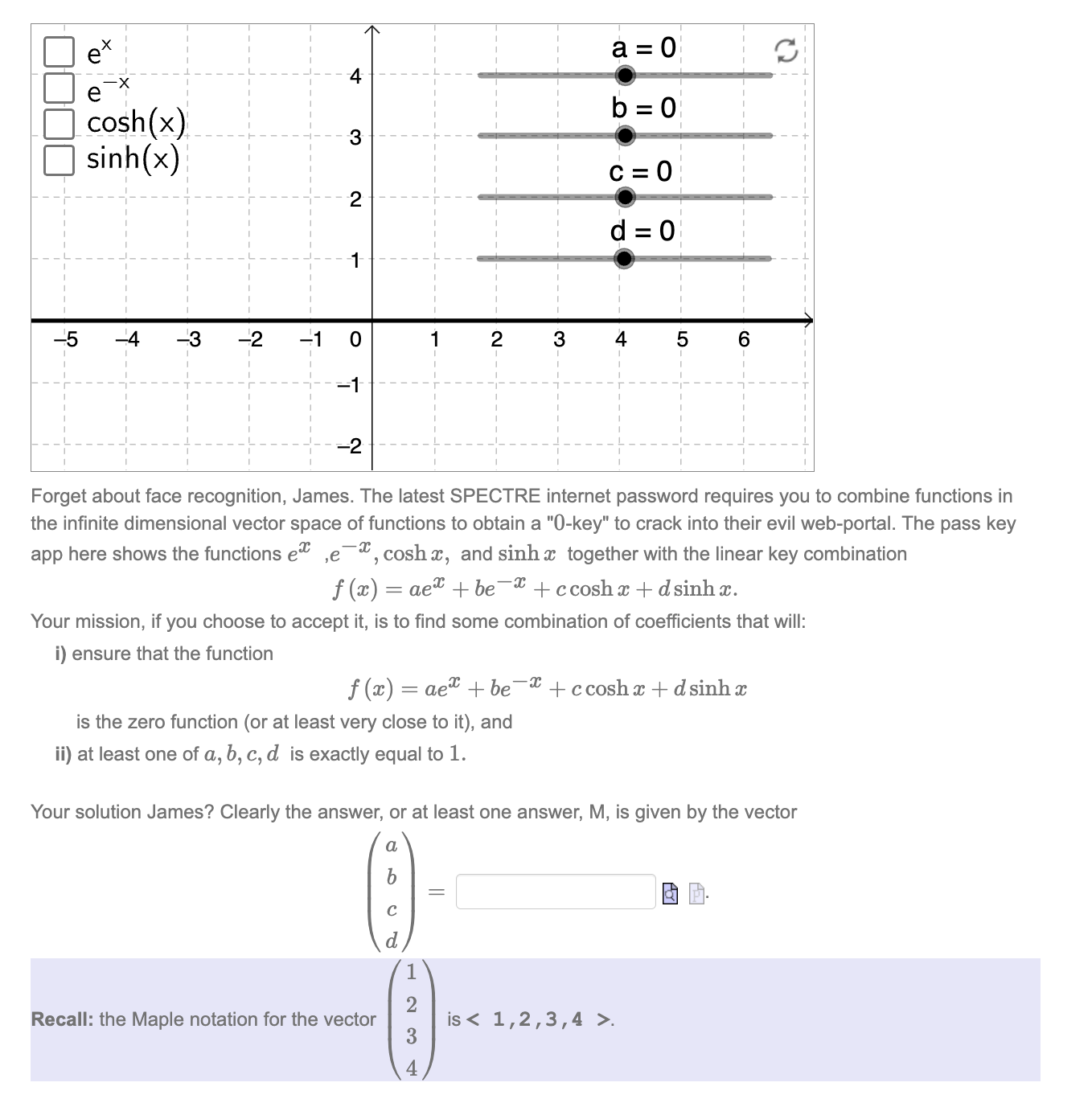
Forget about face recognition, James. The latest SPECTRE internet password requires you to combine functions in the infinite dimensional vector space of functions to obtain a " 0 -key" to crack into their evil web-portal. The pass key app here shows the functions \( e^{x}, e^{-x}, \cosh x \), and \( \sinh x \) together with the linear key combination \[ f(x)=a e^{x}+b e^{-x}+c \cosh x+d \sinh x . \] Your mission, if you choose to accept it, is to find some combination of coefficients that will: i) ensure that the function \[ f(x)=a e^{x}+b e^{-x}+c \cosh x+d \sinh x \] is the zero function (or at least very close to it), and ii) at least one of \( a, b, c, d \) is exactly equal to 1 . Your solution James? Clearly the answer, or at least one answer, M, is given by the vector \[ \left(\begin{array}{l} a \\ b \\ c \\ d \end{array}\right)=\square \text { ?. } \] Recall: the Maple notation for the vector \( \left(\begin{array}{l}1 \\ 2 \\ 3 \\ 4\end{array}\right) \) is \( \langle 1,2,3,4> \).
View Answer
divider