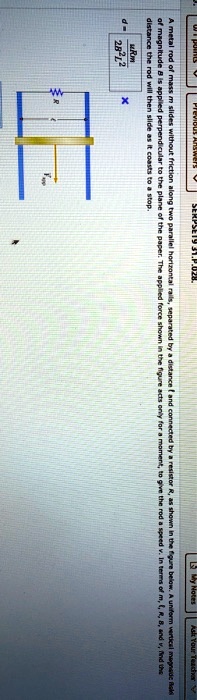
A metal rod of mass $m$ slides without friction along two parallel horizontal rails, separated by a distance $l$ and connected by a resistor $R$, as shown in the figure below. A uniform vertical magnetic field of magnitude $B$ is applied perpendicular to the plane of the paper. The applied force shown in the figure acts only for a moment, to give the rod a speed $v$. In terms of $m$, $l$, $R$, $B$, and $v$, find the distance the rod will then slide as it coasts to a stop.
$d = \frac{uRm}{2B^2l^2}$