Questions asked
The final steps in testing during an implementation and post go-live is ____________. Group of answer choices meaningful use testing ADT testing integration testing volume testing
8. [0/0.83 Points] DETAILS MY NOTES ASWESBE9 8.E.032. For this assignm submissions ren change the answ Assignment Sce Your best submis PREVIOUS ANSWERS You may need to use the appropriate appendix table or technology to answer this question. A simple random sample of 800 elements generates a sample proportion $\hat{p}=0.71$. (Round your answers to four decimal places) (a) Provide a 90% confidence interval for the population proportion. 0.6816 to 0.7384 (b) Provide a 95% confidence interval for the population proportion. 0.6761 to 0.7439 Need Help? esc SUBMIT ANSWER MacBook Pro @ # % A & 1 2 3 4 5 6 7 8 9 Q W E R T Y U 1 C tab A S D F G H J K caps lock n Z X C V B N M T H control option command
xy^('2)+y^('3)=y
$2\mu F$ $7\mu F$ $A$ $12\mu F$ $13\mu F$ $1\mu F$ $10\mu F$ $5\mu F$ $B$
What occurs when electrons are shared between two atoms; neither atom completely loses or gains an electron? Can be in the form of one pair of shared electrons (single bond), two pairs (double bond), three pairs of electrons shared (triple bond).
Your adult patient has an order for 3 mcg/min of amiodarone. The solution comes from pharmacy as 5 mg in 100 ml of D5W. At what rate will you set the infusion pump?
Which one of the following best describes vicarious learning? Remembering reinforcement that one has previously received Receiving reinforcement after behaving inappropriately Anticipating future reinforcement Watching/observing someone else receive reinforcement for a behavior
Which of the following has a larger kinetic energy? 50 kg block moving at 30 m/s 30 kg block moving at 50 m/s Both options have the same kinetic energy
44. Which of the following bone-process pairs are INCORRECTLY associated? scapula - coracoid process ulna - styloid process temporal bone - styloid process atlas (C1) - odontoid process ALL of these are correct
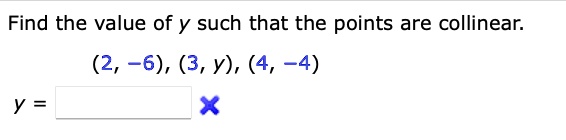
Find the value of y such that the points are collinear. (2, -6), (3, y), (4, -4) y =