Ace - AI Tutor
Ask Our Educators
Textbooks
My Library
Flashcards
Scribe - AI Notes
Notes & Exams
Download App
kelsey johnston

kelsey j.

Divider

Questions asked

BEST MATCH

Assess whether the US economy was operating in the Keynesian, Intermediate, or Neoclassical segment of the Short-Run Aggregate Supply (SRAS) curve in Q4 2019, and justify your conclusion.

View Answer
divider
BEST MATCH

Current Attempt in Progress A certain wire has a resistance of 120 Ω. What is the resistance of a second wire, made of the same material, that is 1/5 as long and has 1/3 the diameter?

View Answer
divider
BEST MATCH

A group of 13 friends wished to stop smoking. They read in a research report that 8.3% of people who attempt to quit using e-cigarettes succeed, and decided that they would try this method. After one month 3 of them had stopped smoking. Assume that the properties of the binomial distribution are satisfied for the following questions. c) Find the mean of the number of people who would quit smoking in a sample of size 13.

View Answer
divider
BEST MATCH

Cengage Learning MindTap - Cengage Learning Ace Al Tutor from Numerade CENGAGE MINDTAP Search this course Complete: Chapter 17 Problem Set The developmental psychologist wants to know if one-week-old infants orient toward the garment of their own father more often than might occur by chance. He plans to use a chi-square test for goodness of fit to test his hypothesis. The null hypothesis, that the one-week-old infants have no preference for the different garments, can be represented by the following, where the values specify the proportion of the population of one-week-old infants who would orient toward each of the garments: \begin{tabular}{cccc} \hline & Actual Father & Unrelated Man \# 1 & Unrelated Man \#2 \\ \hline \( \mathbf{H}_{0}: \) & \( \frac{1}{3} \) & \( \frac{1}{3} \) & \( \frac{1}{3} \) \\ \hline \end{tabular} Fill in the following table with the expected frequencies if the null hypothesis is true: Actual Father Unrelated Man \#1 Unrelated Man \#2 The chi-square statistic is \( x^{2}= \) \( \qquad \) . The distribution of the chi-square statistic has \( \qquad \) degree(s) of freedom. Use the following Distributions tool to find the critical value. Chi-Square Distribution Degrees of Freedam \( =3 \) \( \square \)

View Answer
divider
BEST MATCH

What kind of tone in an email creates the best mood in its readers? strong and authoritative friendly and professional friendly and uncertain

View Answer
divider
BEST MATCH

The price elasticity of demand for health care is such that an increase in the price of health care will Multiple Choice shift the demand for health care leftward. decrease total health care expenditures. shift the demand for health care rightward. increase total health care expenditures.

View Answer
divider
BEST MATCH

Pricing decisions are generally more complicated internationally than domestically. Such pricing decisions are generally influenced by all of the following factors EXCEPT: different levels of governmental intervention. price escalation for exports. changing values of currencies. rising oil prices in the domestic market. greater market diversity and near-monopoly conditions.

View Answer
divider
BEST MATCH

The College Board exams, which are administered each year to many thousands of high school students, are scored so as to yield a mean of 80 and the 16th percentile is 65. These scores have a mound-shaped histogram. Where appropriate, use the empirical rule to answer the following questions. A. What is the approximate value of the standard deviation of exam scores? B. What is the 84th percentile? C. What score has a z-score of 0.6? D. What percentile corresponds to an exam score of 110? E. Do you think there are many scores above 50? Explain.

View Answer
divider
BEST MATCH

Chemical formulas can be determined from ex kaloid in the nightshade family of plants that is mainly r e of cigarettes, contains 74.02% C, 8.710% H, and 17.27% s 0.2500 mol nicotine, what is the molecular formula?

View Answer
divider
BEST MATCH

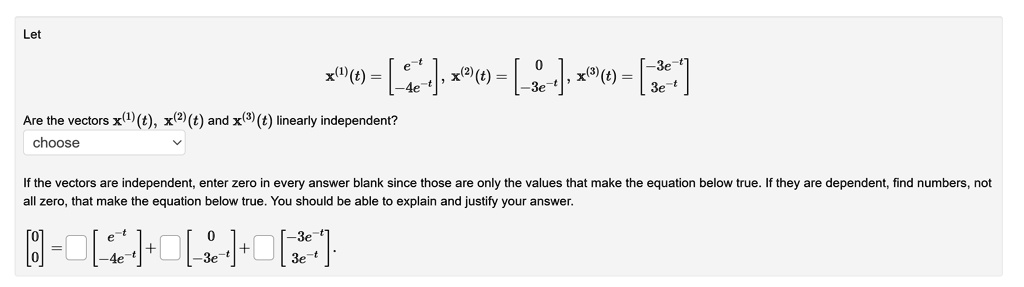
Let $x^{(1)}(t) = \begin{bmatrix} e^{-t} \\ -4e^{-t} \end{bmatrix}$, $x^{(2)}(t) = \begin{bmatrix} 0 \\ -3e^{-t} \end{bmatrix}$, $x^{(3)}(t) = \begin{bmatrix} -3e^{-t} \\ 3e^{-t} \end{bmatrix}$ Are the vectors $x^{(1)}(t)$, $x^{(2)}(t)$ and $x^{(3)}(t)$ linearly independent? choose If the vectors are independent, enter zero in every answer blank since those are only the values that make the equation below true. If they are dependent, find numbers, not all zero, that make the equation below true. You should be able to explain and justify your answer. $\begin{bmatrix} 0 \\ 0 \end{bmatrix} = \boxed{} \begin{bmatrix} e^{-t} \\ -4e^{-t} \end{bmatrix} + \boxed{} \begin{bmatrix} 0 \\ -3e^{-t} \end{bmatrix} + \boxed{} \begin{bmatrix} -3e^{-t} \\ 3e^{-t} \end{bmatrix}$
View Answer
divider