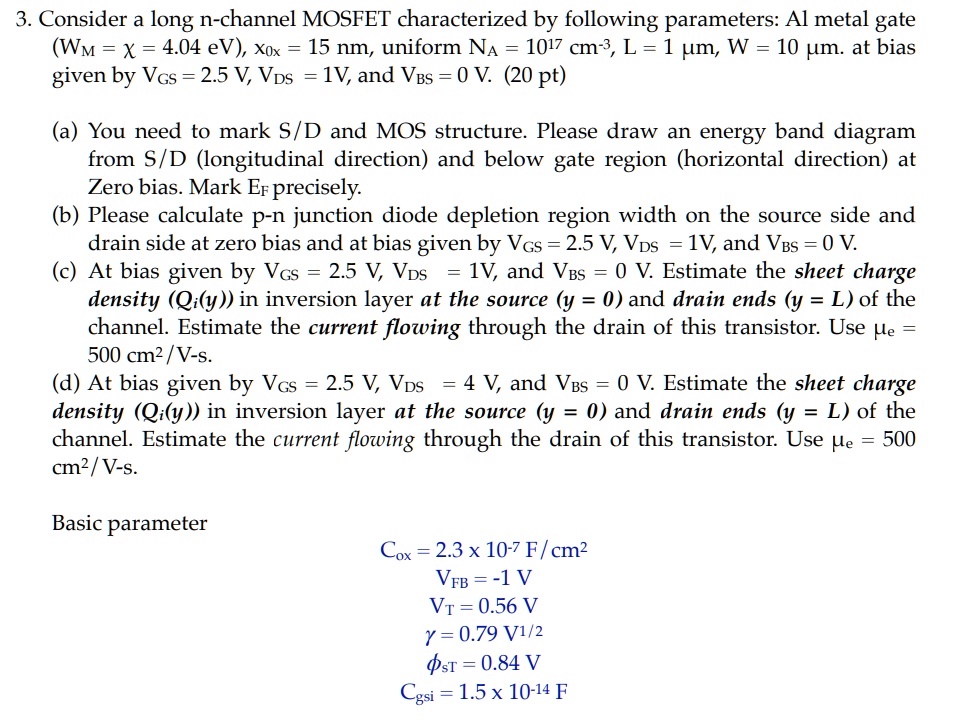
. Consider a long n-channel MOSFET characterized by following parameters: Al metal gateConsider a long n-channel MOSFET characterized by following parameters: Al metal gate
(W_(M)=chi =4.04eV),x_(0x)=15nm, uniform N_(A)=10^(17)cm^(-3),L=1mu m,W=10mu m. at bias
given by V_(GS)=2.5V,V_(DS)=1V, and V_(BS)=0V. (20 pt)
(a) You need to mark S/D and MOS structure. Please draw an energy band diagram
from S/D (longitudinal direction) and below gate region (horizontal direction) at
Zero bias. Mark EF precisely.
(b) Please calculate p-n junction diode depletion region width on the source side and
drain side at zero bias and at bias given by V_(GS)=2.5V,V_(DS)=1V, and V_(BS)=0V.
(c) At bias given by V_(GS)=2.5V,V_(DS)=1V, and V_(BS)=0V. Estimate the sheet charge
density (Q_(i)(y)) in inversion layer at the source (y=0) and drain ends (y=L) of the
channel. Estimate the current flowing through the drain of this transistor. Use mu _(e)=
500c(m^(2))/(V)-s.
(d) At bias given by V_(GS)=2.5V,V_(DS)=4V, and V_(BS)=0V. Estimate the sheet charge
density (Q_(i)(y)) in inversion layer at the source (y=0) and drain ends (y=L) of the
channel. Estimate the current flowing through the drain of this transistor. Use mu _(e)=500
c(m^(2))/(V)-s.
Basic parameter
C_(ox)=2.3 imes 10^(-7)(F)/(c)m^(2)
V_(FB)=-1V
V_(T)=0.56V
gamma =0.79V^((1)/(2))
phi _(sT)=0.84V
C_(gsi)=1.5 imes 10^(-14)F
(WM = chi = 4.04 eV), x0x = 15 nm, uniform NA = 1017 cm-3, L = 1 mu m, W = 10 mu m. at bias
given by VGS = 2.5 V, VDS = 1V, and VBS = 0 V. (20 pt)
(a) You need to mark S/D and MOS structure. Please draw an energy band diagram
from S/D (longitudinal direction) and below gate region (horizontal direction) at
Zero bias. Mark EF precisely.
(b) Please calculate p-n junction diode depletion region width on the source side and
drain side at zero bias and at bias given by VGS = 2.5 V, VDS = 1V, and VBS = 0 V.
(c) At bias given by VGS = 2.5 V, VDS = 1V, and VBS = 0 V. Estimate the sheet charge
density (Qi(y)) in inversion layer at the source (y = 0) and drain ends (y = L) of the
channel. Estimate the current flowing through the drain of this transistor. Use mu e =
500 cm2/V-s.
(d) At bias given by VGS = 2.5 V, VDS = 4 V, and VBS = 0 V. Estimate the sheet charge
density (Qi(y)) in inversion layer at the source (y = 0) and drain ends (y = L) of the
channel. Estimate the current flowing through the drain of this transistor. Use mu e = 500
cm2/V-s.
Basic parameter
Cox = 2.3 x 10⁻⁷ F/cm2
VFB = -1 V
VT = 0.56 V
= 0.79 V1/2
sT = 0.84 V
Cgsi = 1.5 x 10⁻¹⁴ F
3. Consider a long n-channel MOSFET characterized by following parameters: Al metal gate (Wm = X = 4.04 eV), xox = 15 nm, uniform Na = 1017 cm-3, L = 1 um, W = 10 um. at bias given by Vcs =2.5 V,Vps =1V, and Vss =0 V.(20 pt)
(a) You need to mark S/D and MOS structure. Please draw an energy band diagram from S/D (longitudinal direction) and below gate region (horizontal direction) at Zero bias. Mark EF precisely.
drain side at zero bias and at bias given by Vcs = 2.5 V, Vps = 1V, and Vs = 0 V.
(c) At bias given by Vgs = 2.5 V, Vps = 1V, and Vss = 0 V. Estimate the sheet charge density (Qi(y)) in inversion layer at the source (y = 0) and drain ends (y = L) of the channel. Estimate the current flowing through the drain of this transistor. Use ue = 500 cm2/V-s. (d) At bias given by Vgs = 2.5 V, Vps = 4 V, and Vss = 0 V. Estimate the sheet charge density (Qi(y)) in inversion layer at the source (y = 0) and drain ends (y = L) of the channel. Estimate the current flowing through the drain of this transistor. Use ue = 500 cm2/V-s.
Basic parameter
Cox = 2.3 x 10⁻⁷ F/cm2 VFB = -1 V VT=0.56 V = 0.79 V1/2 qsT =0.84 V Cgsi = 1.5 x 10⁻¹⁴ F