Ace - AI Tutor
Ask Our Educators
Textbooks
My Library
Flashcards
Scribe - AI Notes
Notes & Exams
Download App
kendra stewart

kendra s.

Divider

Questions asked

BEST MATCH

How many grams of cobalt(II) nitrite contain 1.94 grams of Co2+?

View Answer
divider
BEST MATCH

aluminum and oxygen react to form aluminum oxide by the equation _Al(s) +__02(g) ->_Al203(s) In a certain experiment, 137 g of Al203 are produced from 75.6 g of Al and 124 g of 02. a. What is the theoretical yield of A1,03?

View Answer
divider
BEST MATCH

Most people desire to be in relationships that are give and take, promoting equal responsibility and effort. This is known as... uncertainty reduction. interdependence. communication competence. reciprocity.

View Answer
divider
BEST MATCH

Why are sexual disorders often associated with such stigma? Use examples to help strengthen your point of view.

View Answer
divider
BEST MATCH

Which component of language below is CORRECTLY matched with its description? phoneme-meaning syntax-speech sounds morpheme-word order None of these is correctly matched.

View Answer
divider
BEST MATCH

Calcular la intensidad del campo en el interior de la bobina de la figura. El número de espiras de la misma es de 300; la corriente 10A y convertir en un circuito magnético $I = 10 A$ $N = 300$ 20 cm 4 cm 20 cm

View Answer
divider
BEST MATCH

Problem #2 The cost function of a firm producing a certain good is given by TC=250+10Q+2.5Q² 1. Determine the fixed cost (FC) when the firm produces Q=0 unit of output 2. Determine the fixed cost (FC) when the firm produces Q=10 units of output 3. Determine the variable cost (VC) when the firm produces Q=10 units of output 4. Determine the Total cost (TC) when the firm produces Q=10 units of output 5. Determine the average fixed cost (AFC) when the firm produces Q=10 units of output 6. Determine the average variable cost (AVC) when the firm produces Q=10 units of output 7. Determine the average total cost (ATC) when the firm produces Q=10 units of output 8. Determine the marginal cost (MC) of producing the 10th unit of output. Do NOT use derivative!

View Answer
divider
BEST MATCH

In the traditional specific factors model described in class: A. Capital is defined as a mobile factor and land is defined as fixed. B. Capital is defined as a fixed factor and land is defined as mobile. C. Labor is defined as a fixed factor and capital and land are defined as mobile. D. All of the options provided are correct. E. None of the options provided are correct.

View Answer
divider
BEST MATCH

2.4 FM Modulation and Demodulation of Voice Signal Apply the FM modulator and demodulator designed above to a voice signal. You may use the same signal you recorded for Project #1. Group the Matlab scripts of the following three tasks as one M file. You may use a carrier frequency of 5-10KHz and $K_f$ around $10^5$. Display the spectrum plots of the original baseband signal, the FM modulated signal, and the demodulated signal. Amplify your demodulated signal properly so that you can hear it. You may listen to the signal with sound(FM_dem, fs); Is the demodulated signal noisy? What are the possible resources of the noise you experience?

View Answer
divider
BEST MATCH

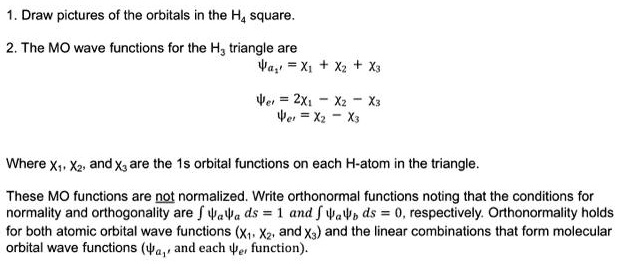
1. Draw pictures of the orbitals in the H? square. 2. The MO wave functions for the H? triangle are $\Psi_{a_1} = \chi_1 + \chi_2 + \chi_3$ $\Psi_{e_1} = 2\chi_1 - \chi_2 - \chi_3$ $\Psi_{e_2} = \chi_2 - \chi_3$ Where $\chi_1$, $\chi_2$, and $\chi_3$ are the 1s orbital functions on each H-atom in the triangle. These MO functions are not normalized. Write orthonormal functions noting that the conditions for normality and orthogonality are $\int \psi_a \psi_a ds = 1$ and $\int \psi_a \psi_b ds = 0$, respectively. Orthonormality holds for both atomic orbital wave functions ($\chi_1$, $\chi_2$, and $\chi_3$) and the linear combinations that form molecular orbital wave functions ($\psi_{a_1}$, and each $\psi_{e_i}$ function).
View Answer
divider