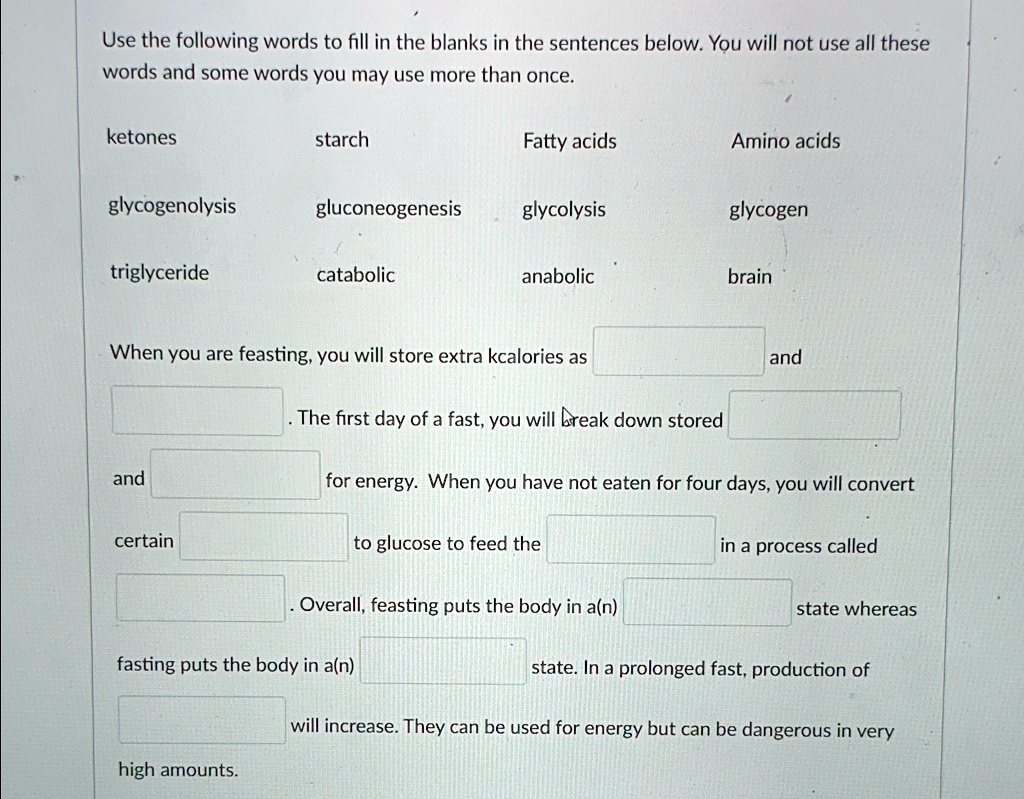
Use the following words to fill in the blanks in the sentences below. You will not use all these words and some words you may use more than once.
able[[ketones,starch,Fatty acids,Amino acids],[glycogenolysis,gluconeogenesis,glycolysis,glycogen],[triglyceride,catabolic,anabolic,brain]]
When you are feasting, you will store extra kcalories as ◻ and
◻ The first day of a fast, you will break down stored
and ◻ for energy. When you have not eaten for four days, you will convert certain ◻ to glucose to feed the ◻ in a process called
◻ . Overall, feasting puts the body in a(n) ◻ state whereas fasting puts the body in a(n) ◻ state. In a prolonged fast, production of
◻ will increase. They can be used for energy but can be dangerous in very high amounts.
Use the following words to fill in the blanks in the sentences below. You will not use all these words and some words you may use more than once
ketones
starch
Fatty acids
Amino acids
glycogenolysis
gluconeogenesis
glycolysis
glycogen
triglyceride
catabolic
anabolic
brain
When you are feasting, you will store extra kcalories as
and
The first day of a fast, you will reak down stored
and
for energy.When you have not eaten for four days,you will convert
certain
to glucose to feed the
in a process called
Overall, feasting puts the body in a(n)
state whereas
fasting puts the body in a(n)
state. In a prolonged fast,production of
will increase.They can be used for energy but can be dangerous in very
high amounts.