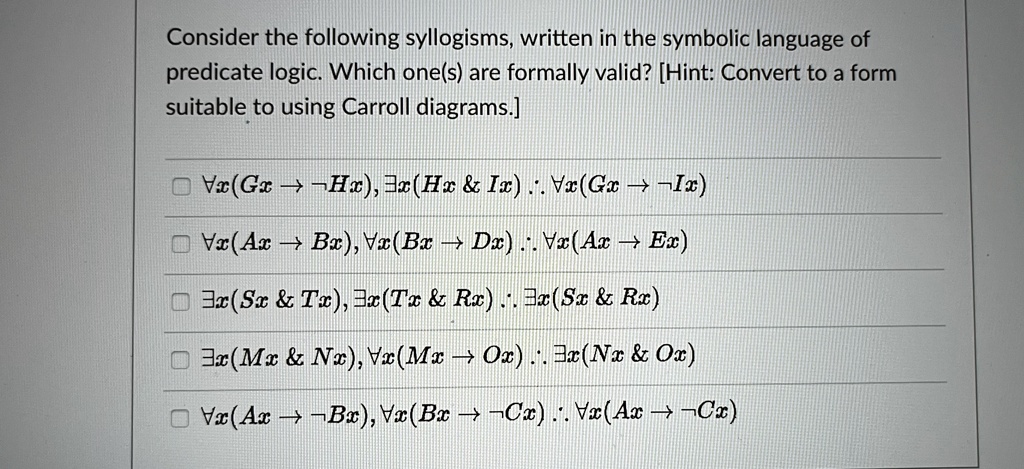
Consider the following syllogisms, written in the symbolic language of
predicate logic. Which one(s) are formally valid? [Hint: Convert to a form
suitable to using Carroll diagrams.]
$\forall x (Gx \rightarrow \neg Hx), \exists x (Hx \land Ix) : \forall x (Gx \rightarrow \neg Ix)$
$\forall x (Ax \rightarrow Bx), \forall x (Bx \rightarrow Dx) : \forall x (Ax \rightarrow Ex)$
$\exists x (Sx \land Tx), \exists x (Tx \land Rx) : \exists x (Sx \land Rx)$
$\exists x (Mx \land Nx), \forall x (Mx \rightarrow Ox) : \exists x (Nx \land Ox)$
$\forall x (Ax \rightarrow \neg Bx), \forall x (Bx \rightarrow \neg Cx) : \forall x (Ax \rightarrow \neg Cx)$