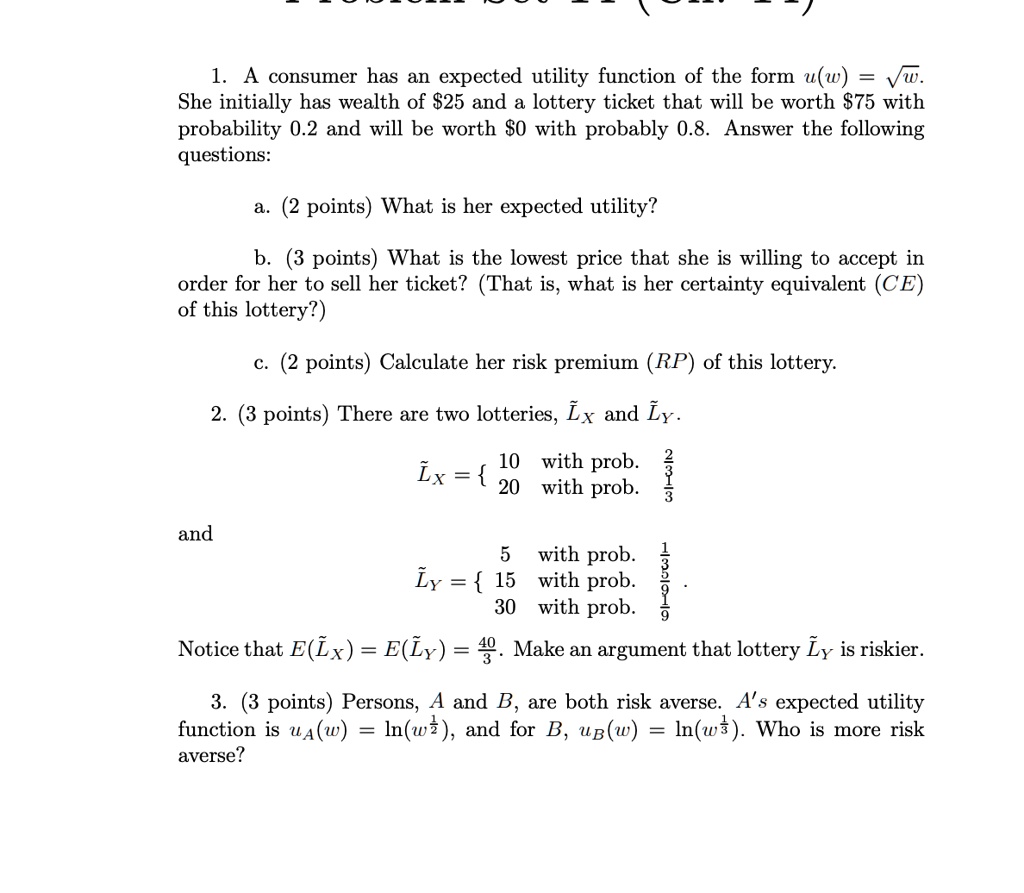
1. A consumer has an expected utility function of the form $u(w) = \sqrt{w}$.
She initially has wealth of $25 and a lottery ticket that will be worth $75 with
probability 0.2 and will be worth $0 with probably 0.8. Answer the following
questions:
a. (2 points) What is her expected utility?
b. (3 points) What is the lowest price that she is willing to accept in
order for her to sell her ticket? (That is, what is her certainty equivalent ($CE$)
of this lottery?)
c. (2 points) Calculate her risk premium ($RP$) of this lottery.
2. (3 points) There are two lotteries, $L_x$ and $L_y$.
$L_x = \begin{cases} 10 & \text{with prob. } \frac{2}{3} \\ 20 & \text{with prob. } \frac{1}{3} \end{cases}$
and
$L_y = \begin{cases} 5 & \text{with prob. } \frac{1}{9} \\ 15 & \text{with prob. } \frac{3}{9} \\ 30 & \text{with prob. } \frac{5}{9} \end{cases}$
Notice that $E(L_x) = E(L_y) = \frac{40}{3}$. Make an argument that lottery $L_y$ is riskier.
3. (3 points) Persons, A and B, are both risk averse. A's expected utility
function is $u_A(w) = \ln(w^{\frac{1}{2}})$, and for B, $u_B(w) = \ln(w^{\frac{1}{4}})$. Who is more risk
averse?