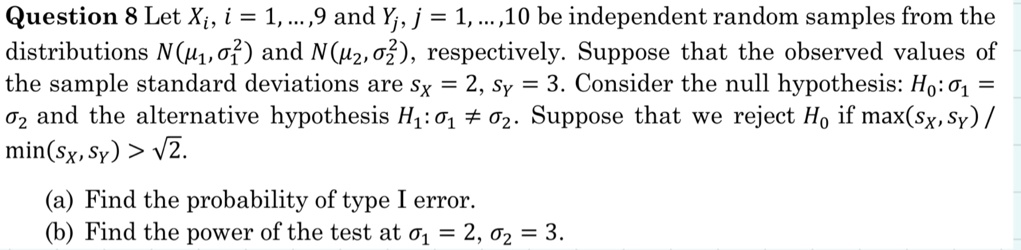
Question 8 Let $X_i$, $i = 1, \dots, 9$ and $Y_j$, $j = 1, \dots, 10$ be independent random samples from the distributions $N(\mu_1, \sigma_1^2)$ and $N(\mu_2, \sigma_2^2)$, respectively. Suppose that the observed values of the sample standard deviations are $s_x = 2$, $s_y = 3$. Consider the null hypothesis: $H_0: \sigma_1 = \sigma_2$ and the alternative hypothesis $H_1: \sigma_1 \ne \sigma_2$. Suppose that we reject $H_0$ if $\frac{\max(s_x, s_y)}{\min(s_x, s_y)} > \sqrt{2}$.
(a) Find the probability of type I error.
(b) Find the power of the test at $\sigma_1 = 2$, $\sigma_2 = 3$.