Part 2: Fundamental Concepts in Financial Management
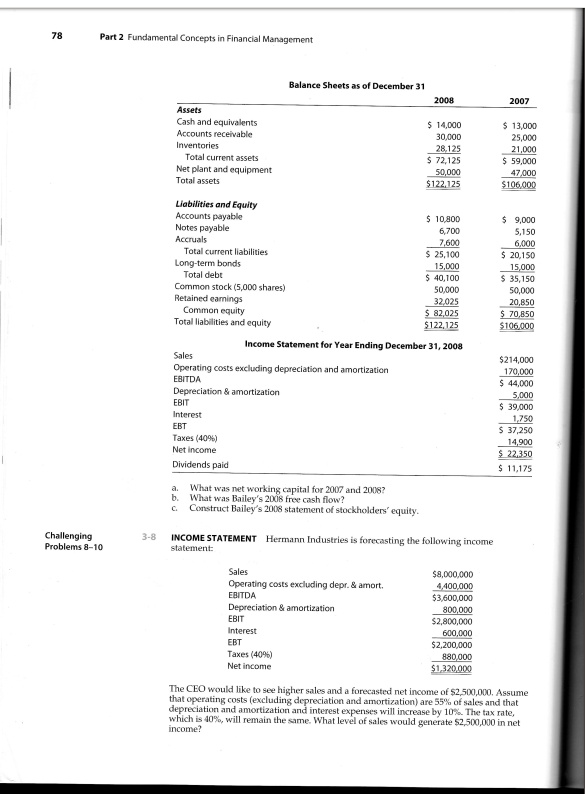
Balance Sheets as of December 31, 2008
Assets
Cash and equivalents: $14,000
Accounts receivable: $30,000
Inventories: $28,125
Total current assets: $72,125
Net plant and equipment: $50,000
Total assets: $122,125
Liabilities and Equity
Accounts payable: $10,800
Notes payable: $6,700
Accruals: $7,600
Total current liabilities: $25,100
Long-term bonds: $15,000
Total debt: $40,100
Common stock (5,000 shares): $50,000
Retained earnings: $32,025
Common equity: $82,025
Total liabilities and equity: $122,125
Income Statement for Year Ending December 31, 2008
Sales: $9,000
Operating costs excluding depreciation and amortization: $5,150
EBITDA: $6,000
Depreciation & amortization: $15,000
EBIT: $35,150
Interest: $50,000
EBT: $20,850
Taxes (40%): $70,850
Net income: $106,000
Dividends paid: $214,000
a. What was the net working capital for 2007 and 2008?
b. What was Bailey's 2008 free cash flow?
*3 Construct Bailey's 2008 statement of stockholders' equity.
Challenging Problems 810
3-8 INCOME STATEMENT
Hermann Industries is forecasting the following income statement:
Sales: $8,000,000
Operating costs excluding depreciation & amortization: $4,400,000
EBITDA: $3,600,000
Depreciation & amortization: $800,000
EBIT: $2,800,000
Interest: $600,000
EBT: $2,200,000
Taxes (40%): $880,000
Net income: $1,320,000
The CEO would like to see higher sales and a forecasted net income of $2,500,000. Assume that operating costs (excluding depreciation and amortization) are 55% of sales and that depreciation and amortization and interest expenses will increase by 10%. The tax rate, which is 40%, will remain the same. What level of sales would generate $2,500,000 in net income?