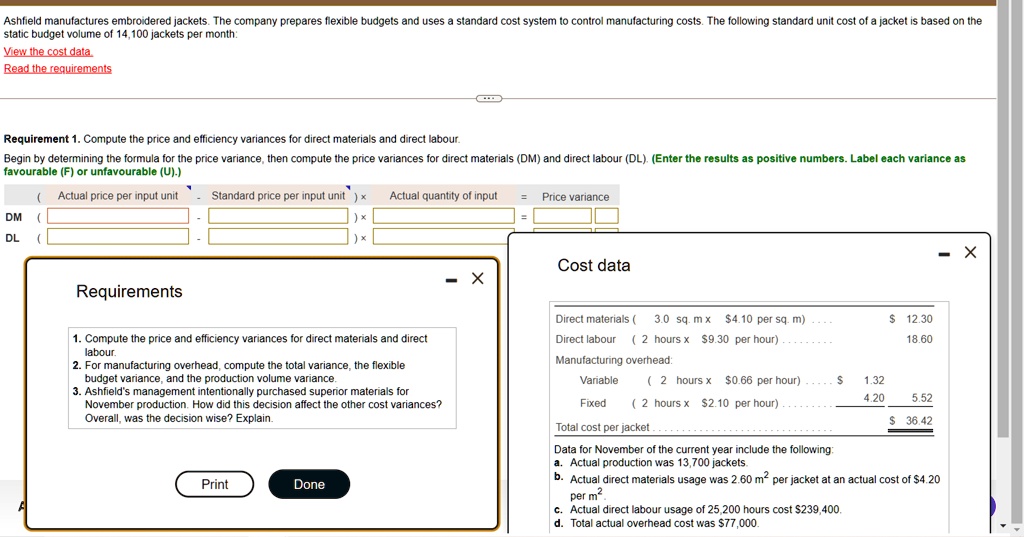
Ashfield manufactures embroidered jackets. The company prepares flexible budgets and uses a standard cost system to control manufacturing costs. The following standard unit cost of a jacket is based on the
static budget volume of 14,100 jackets per month:
View the cost data.
Read the requirements
Requirement 1. Compute the price and efficiency variances for direct materials and direct labour.
Begin by determining the formula for the price variance, then compute the price variances for direct materials (DM) and direct labour (DL). (Enter the results as positive numbers. Label each variance as
favourable (F) or unfavourable (U).)
(
Actual price per input unit
Standard price per input unit) x Actual quantity of input
Price variance
DM
DL
Requirements
1. Compute the price and efficiency variances for direct materials and direct
labour.
2. For manufacturing overhead, compute the total variance, the flexible
budget variance, and the production volume variance.
3. Ashfield's management intentionally purchased superior materials for
November production. How did this decision affect the other cost variances?
Overall, was the decision wise? Explain.
Print
Done
Cost data
X
Direct materials ( 3.0 sq. m x $4.10 per sq. m)
Direct labour (2 hours x $9.30 per hour)
Manufacturing overhead:
$ 12.30
18.60
Variable
(2 hours x $0.66 per hour)
S
Fixed
(2 hours x $2.10 per hour)
1.32
4.20
5.52
$ 36.42
Total cost per jacket......
Data for November of the current year include the following:
a. Actual production was 13,700 jackets.
b. Actual direct materials usage was 2.60 m² per jacket at an actual cost of $4.20
per m²
c. Actual direct labour usage of 25,200 hours cost $239,400.
d. Total actual overhead cost was $77,000.
X